

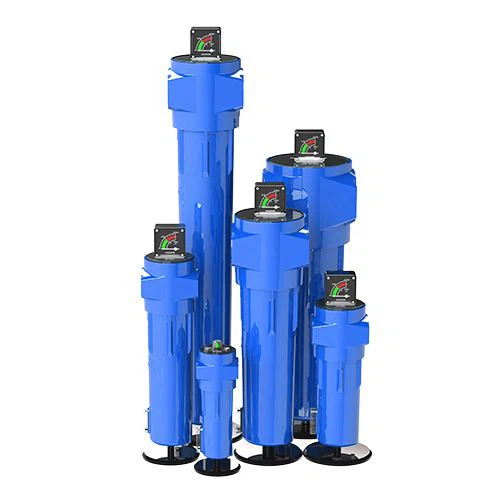
High-pressure air filters usually incorporate multiple stages of filtration to achieve maximum efficiency:
Pre-Filtration (Mechanical Filtration): The first stage typically uses a mechanical filter made of stainless steel mesh or sintered material. This component traps larger particles like dust, rust, and other solid impurities. As the compressed air passes through this layer, it removes the bulk of contaminants, reducing the overall particle load.
Coalescing Filtration (Oil and Water Removal): The second stage is often a coalescing filter. This filter is essential for removing aerosols of oil and water, which are often present in compressed air systems due to the lubrication processes or moisture in the atmosphere. In this stage, small droplets of oil and water combine (coalesce) into larger droplets as the air moves through a densely packed filter media, which is usually made of micro-glass fibers. These larger droplets are then collected and drained from the system, resulting in dry, oil-free air.
Adsorption Filtration (Odor and Vapor Removal): For applications that require ultra-pure air, a third stage is sometimes added that uses an adsorption filter, typically filled with activated carbon. This stage removes any remaining oil vapor, odors, and volatile organic compounds (VOCs). The activated carbon works through a process of adsorption, where gas molecules are attracted and adhere to the surface of the carbon, leaving the air free from vapor contaminants.
Fine Particle Filtration (Final Stage): In high-pressure environments, a final filtration stage is necessary to capture the smallest particles, often down to 0.01 microns. This filter ensures that any remaining solid impurities that passed through the previous stages are trapped. This stage is critical in applications such as pharmaceuticals, food processing, and electronics, where even minute particles can cause defects or contamination.


Products Certificate

why choose us?
Ultra-Low Dew Points: By achieving very low dew points, they effectively protect sensitive downstream equipment and processes from moisture damage.
Enhanced Equipment Longevity: The removal of moisture from compressed air reduces the risk of corrosion and wear in air-powered tools and machinery, extending their operational lifespan.
Energy Efficiency: Some desiccant filter designs offer energy-saving features, such as low purge air consumption in regeneration processes, helping reduce the overall energy costs of compressed air systems.
Adaptability: These filters can be used across a wide range of industries and applications, offering customizable configurations based on specific air purity requirements.
one-stop solution
professional team
high quality
FAQ
1.What are the main contaminants removed by high-pressure air filters?
They primarily remove dust particles, oil aerosols, water droplets, and other impurities from compressed air. In advanced filtration systems, they also remove odors, oil vapors, and volatile organic compounds (VOCs) through adsorption filtration, typically with activated carbon. This multi-stage filtration ensures that the air meets industry standards for cleanliness and purity, preventing equipment damage and ensuring product quality.
2.How do coalescing filters in high-pressure air filters remove water and oil?
Coalescing filters work by forcing compressed air through a densely packed media, usually made of fine glass fibers. As the air passes through, small oil and water droplets combine into larger droplets, a process known as coalescence. These larger droplets are then collected at the bottom of the filter housing and automatically drained from the system, ensuring the air exiting the filter is free from liquids and moisture.
3.Why is high-pressure filtration essential in industries like aerospace and pharmaceuticals?
In industries like aerospace and pharmaceuticals, the quality of compressed air is critical to operational success. In aerospace, pneumatic tools and testing systems require clean, oil-free air to function correctly and avoid contamination. In pharmaceuticals, the air used in manufacturing processes must be sterile, oil-free, and devoid of particles to prevent contamination of products, which could compromise safety and efficacy. They ensure that the air meets stringent quality standards in these sensitive environments.
4.How does a compressed air filter handle extreme pressures compared to standard air filters?
They are built with robust materials like stainless steel or aluminum to withstand the high forces exerted by compressed air at pressures above 200 bar (2900 psi). The filter housing is designed to resist deformation and prevent leaks under extreme pressure. The filtration media inside is specially designed to maintain its structure and filtration efficiency despite the higher pressure differentials, ensuring that contaminants are effectively removed without compromising the integrity of the filter or air quality.
5.When should the filter element in a high-pressure air filter be replaced?
The filter element should be replaced when the pressure differential across the filter exceeds the manufacturer's recommended limit. Most compressed air filters are equipped with pressure differential indicators, which alert users when the filter is becoming clogged with contaminants. If the filter is not replaced in a timely manner, the increased pressure drop can reduce airflow efficiency, strain the system, and eventually cause damage to downstream equipment. Regular maintenance based on the indicator's readings is essential for optimal performance.


