

In industrial production, air dryers are the core equipment to ensure the quality of compressed air. However, if the size of the air dryer is not selected properly, it will not only limit the installation space of the equipment, but also affect the drying efficiency and increase energy consumption costs. Therefore, how to scientifically and accurately calculate the size of the air dryer has become an important issue for industrial enterprises when selecting equipment.
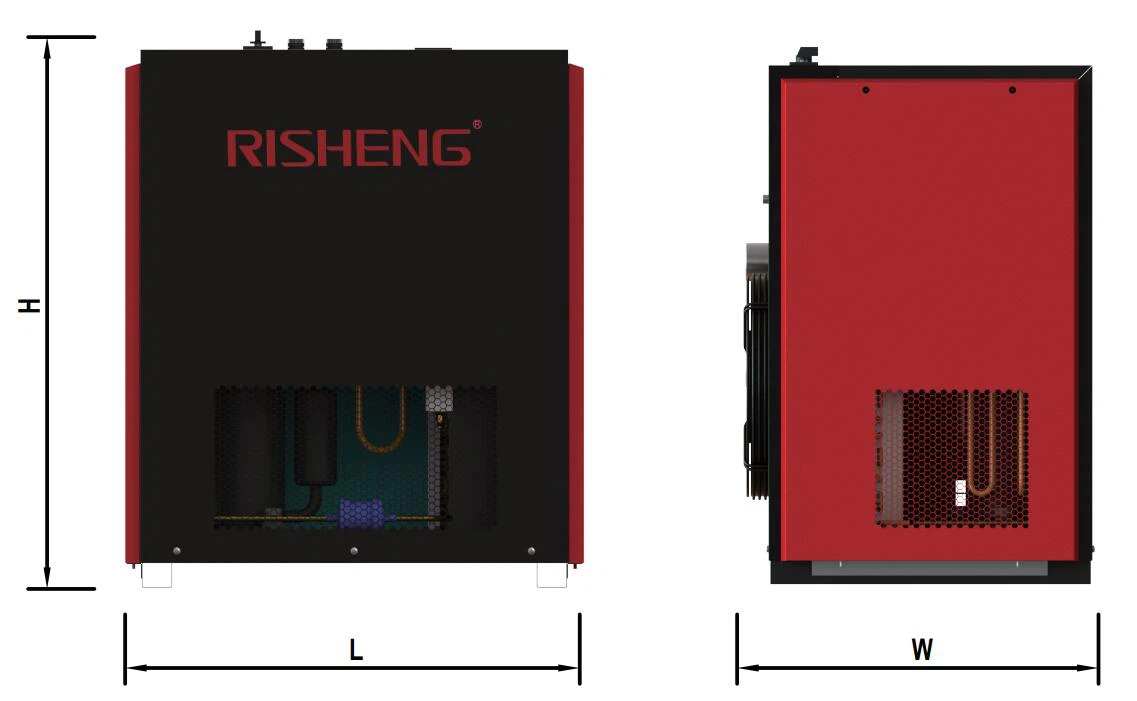
Table of contents
Key parameters for sizing calculation
(1.) Air volume
(2.) Air intake conditions
(3.) Air outlet requirements
Specific methods for sizing calculation
(1.) Sizing calculation for adsorption air dryers
(2.) Sizing calculation for refrigerated air dryers
(3.) Sizing calculation for membrane air dryers
Industry practices and cases for sizing calculation
Future development trends of sizing calculation
Key parameters for size calculation
Gas handling volume
Gas handling volume refers to the volume of compressed air that the air dryer can handle per unit time, usually in standard cubic meters per minute (Nm'/min). It is the most basic parameter to determine the size of the air dryer. The gas handling volume needs to be determined based on the total gas consumption of the company's actual gas-using equipment and the future gas growth demand. For example, a mechanical processing workshop has a total of 10 pneumatic equipment, and the gas consumption of each equipment is 0.5 Nm'/min. At the same time, the utilization coefficient is 0.8, then the theoretical gas handling volume demand of the workshop is 10x0.5x0.8=4NmÁ /min.
Inlet conditions
Inlet conditions include inlet pressure, temperature and humidity. Inlet pressure is generally measured in megapascals (MPa). Different types of air dryers have a certain range of adaptability to inlet pressure. Excessively high inlet temperatures can affect the performance of the adsorbent or refrigeration system. Common air dryers are suitable for inlet temperatures below 40°C. Inlet humidity determines the amount of moisture that the air dryer needs to remove, usually expressed in water content (g/Nm³) or relative humidity.
Outlet requirements
Outlet requirements mainly refer to the dew point temperature of the compressed air after drying, which reflects the degree of air dryness. Different industries have different requirements for dew point temperature. The electronic semiconductor industry may require a dew point temperature as low as -70°C, while the general machinery manufacturing industry can meet the requirements with a dew point temperature of around -20°C. In addition, requirements for impurities such as oil content and solid particles in the outlet air will also affect the configuration and size calculation of the dryer.
Specific method of size calculation
Size calculation of adsorption air dryer
The diameter and height of the drying tower of the adsorption air dryer are mainly determined by the gas volume and adsorption cycle. The calculation formula of the drying tower diameter is 4Q, where D is the diameter of the drying tower (m), Q is the gas volume (m/s), and D is the gas velocity in the tower: D=1T2 (m/s), which is generally 0.1-0.3 m/s. The height of the drying tower needs to consider the loading amount of the adsorbent. It is usually designed according to empirical formulas and actual working conditions, and the height generally ranges from 2-5 meters.
Refrigerated Air Dryer Sizing
The key point of the size calculation of the refrigerated air dryer is the matching of the refrigeration system. According to the processing gas volume and the temperature requirements of the inlet and outlet air, the appropriate refrigeration compressor, condenser, evaporator and other components are selected by calculating the required refrigeration capacity. For example, if the processing gas volume is Q (Nm'/min), the inlet temperature is 1 (°C), and the outlet temperature is 12 (°C), the refrigeration capacity can be calculated by the formula Q =cxpxQx (1-1) (where c is the specific heat capacity of compressed air and p is the density of compressed air), and then the corresponding specifications of refrigeration equipment are selected according to the refrigeration capacity to determine the overall size of the dryer.
Membrane Air Dryer Sizing
The size of the membrane air dryer mainly depends on the number and arrangement of membrane components. According to the gas volume to be processed and the required degree of drying, the required membrane area is calculated, and then the specifications and number of membrane components are determined. For example, if the gas volume processed by a single membrane component of a certain model is 9 (Nm'/min) and the required gas volume to be processed is Q (Nm'/min), then the number of membrane components required is n = 1/2. Combined with the outer dimensions of the membrane components, the overall size of the dryer is determined.
Industry practices and cases of size calculation
A food and beverage company built a new production line and needed to configure an air dryer. According to calculations, the production line processes 8Nm'/min of gas, the inlet pressure is 0.8 MPa, the inlet temperature is 35℃, and the outlet dew point temperature is required to be -20℃. According to the above calculation method, a refrigerated air dryer was selected. By calculating the cooling capacity of 12kW, the compressor and condenser and other components with corresponding cooling capacity were finally selected, and the overall dimensions of the dryer were determined to be 2.5 meters long, 1.2 meters wide, and 1.8 meters high. After the equipment was put into use, it operated stably and fully met the production needs.
| Parameter type | Specific parameters | Case value |
| Processing gas volume | Unit: Nm³/min | 8 |
| Inlet pressure | Unit: MPa | 0.8 |
| Inlet temperature | Unit: ℃ | 35 |
| Outlet dew point temperature | Unit: ℃ | -20 |
| Cooling capacity | Unit: kW | 12 |
| Equipment size | Length × Width × Height (m) | 2.5×1.2×1.8 |
Future development trend of size calculation
As industrial production develops towards intelligence and refinement, air dryer size calculation will also become more intelligent and accurate. In the future, with the help of big data and artificial intelligence technology, air dryer size selection solutions can be provided to enterprises quickly and accurately based on historical data of different industries and working conditions. At the same time, modular air dryers will be more widely used. Enterprises can flexibly combine modules according to actual needs to achieve personalized customization of dryer size, further improving the adaptability and operating efficiency of equipment.