

In the roaring workshops of steel mills, the sterile clean rooms of pharmaceutical factories, and the high-speed operation of food processing lines, compressed air is like the "blood" of industry, driving equipment, controlling valves, and blowing packages. However, few people realize that there is a fatal threat hidden in these compressed air - moisture. Untreated wet air can cause equipment rust, product deterioration, energy waste, and even cause explosion risks. The air dryer is the core weapon in this "water war".

↑RSXW↑
↓RSXB↓

↑RSXY↑
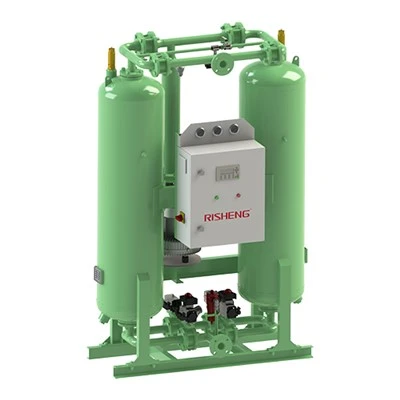
As a leader in the field of global industrial air treatment, the Air Dryer Tower launched by China's Risheng Group not only redefines the technical limits of air dryers, but also provides a set of "water-free" solutions for the global manufacturing industry with intelligent and green innovative concepts.
Air Dryer - "dehumidification Guardian" Of Industrial Compressed Air
Hazards Of Moisture In Compressed Air: From Corrosion To Disaster
When ambient air is compressed to 8-10 times the standard atmospheric pressure, its relative humidity will rise sharply to more than 100%, forming a mixture of liquid water, water vapor and aerosol. These moisture may cause multiple hazards in industrial scenarios:
Equipment damage: Water and lubricating oil mix to form acidic substances, which corrode pneumatic components, cylinders and valves, resulting in a 30%-50% shortening of equipment life.
Production accidents: In processes such as spraying and laser cutting, moisture causes coating bubbles and optical lens atomization; in natural gas pipelines, liquid water and methane may mix to form combustible ice, blocking pipelines and even causing explosions.
Energy waste: According to statistics from the International Energy Agency (IEA), humid compressed air can cause the efficiency of pneumatic systems to decrease by 15%-20%, and the global industry consumes an additional 120 billion kilowatt-hours of electricity each year, equivalent to the annual power generation of 1.5 Three Gorges Power Stations.
The Core Mission Of Air Dryers: "killing All Moisture"
The core function of air dryers is to reduce the pressure dew point (PDP) of compressed air to an extremely low level (usually -20°C to -70°C) through physical or chemical means, ensuring that moisture exists in gaseous form and avoiding liquid precipitation. According to the technical principle, mainstream dryers can be divided into four categories:
Refrigerated dryer: Cools air to 2-5°C through refrigerant to condense and separate moisture. Low cost but limited dew point, suitable for general manufacturing.
Adsorption dryer: Uses silica gel, molecular sieve and other materials to absorb moisture, and desorbs by heating or purge during regeneration. Can achieve dew points below -40°C, but high energy consumption.
Membrane dryer: Uses selective permeable membrane to separate water molecules, compact structure but small processing capacity, often used in laboratories.
Chemical absorption dryer: Absorbs moisture through solutions such as lithium chloride, complex maintenance and easy to pollute the air, and is gradually being eliminated.
However, traditional dryers have long faced three major pain points: Excessive energy consumption (adsorption regeneration consumes 15%-30% of compressed air), dew point fluctuations (flow changes lead to unstable performance), and frequent maintenance (short adsorbent life and high replacement costs). These problems are particularly prominent in emerging fields such as high-end manufacturing and new energy.
Risheng Air Drying Tower - Technical Code to Crack Industry Pain Points
Material Revolution: "molecular Catcher" Of Three-layer Composite Adsorbent
The Risheng technical team found that the microporous structure of traditional adsorbents (such as alumina and molecular sieves) is single, and it is difficult to balance high adsorption capacity and rapid regeneration.
The first layer (MOF-207): It has a super-large pore of 2.8 nanometers, which can quickly adsorb a large amount of water molecules in a high humidity environment, and the adsorption capacity reaches 1.2 g/g, which is 3 times that of traditional molecular sieves.
The second layer (graphene aerogel): using its ultra-high thermal conductivity (500 W/m·K), heat is evenly transferred to the deep layer of the adsorbent during the regeneration stage, increasing the desorption rate by 40%.
The third layer (modified zeolite): through surface sulfonic acid group modification, it selectively captures residual trace moisture and stably controls the dew point below "-70°C".
This "division of labor and cooperation" structure enables TLCD to achieve more than 50,000 adsorption-regeneration cycles in laboratory tests, and its life is more than 5 times longer than that of traditional materials.
Intelligent Control: Dynamic Dew Point Tracking And Ai Prediction Algorithm
Traditional dryers usually use a regeneration mode triggered by a fixed time or pressure difference, which cannot adapt to actual working condition fluctuations. Risheng's Dynamic Dew Point Tracking System (DDPTS) installs a laser spectral humidity sensor at the outlet of the drying tower to monitor the dew point in real time at a frequency of 100 times per second, and predicts the humidity change trend in the next 30 minutes through an AI algorithm.
Dynamically adjust the regeneration cycle: When the intake humidity drops, the system automatically extends the adsorption cycle and reduces the regeneration frequency. In actual measurements at automobile factories, energy consumption was reduced by 38%.
Fault self-diagnosis: By analyzing the pressure curve and temperature fluctuations, AI can warn of faults such as adsorbent aging and valve leakage 14 days in advance, with an accuracy rate of 92%.
Zero-carbon Regeneration: Innovation In Waste Heat Recovery And Green Hydrogen Drive
The regeneration of traditional adsorption dryers consumes a lot of electricity or compressed air. Risheng proposes two green solutions:
Waste heat recovery regeneration (WHR mode): Linked with the air compressor, the 90°C waste heat generated by the air compressor is introduced into the drying tower regeneration module to reduce the regeneration energy consumption to zero. This technology has been applied in a steel plant, reducing carbon emissions by 1,200 tons per year.
Green hydrogen driven regeneration (HyDry mode): In areas rich in hydrogen energy, oxygen and hydrogen produced by water electrolysis are used for combustion and heating to achieve zero carbon emissions throughout the process.
From The Laboratory To The Global Factory - Risheng Drying Tower Practical Case
Semiconductor Industry: Guarding The "ultra-clean Lungs" Of Chip Manufacturing
TSMC's 7-nanometer chip production line requires a dew point of compressed air as high as "-70°C", and oil and particulate matter must be absolutely avoided. Risheng customized a drying tower with integrated HEPA filtration and TLCD adsorption for it, successfully improving the cleanliness to ISO 8573-1 Class 0 (oil-free, particle-free, dew point -70°C), and the yield rate increased by 0.7%.
Hydrogen Energy Industry: Sweeping The "last Drop Of Water" For Green Hydrogen Preparation
In the electrolyzer project of Sunshine Hydrogen Energy, the Risheng drying tower stabilized the dew point of the air used for electrolysis at "-60°C" through the HyDry mode, increasing the efficiency of the proton exchange membrane (PEM) electrolyzer to 85%, and reducing the power consumption per kilogram of hydrogen to 48 kWh (the industry average is 52-55 kWh).
Food And Beverage: Let Every Bottle Of Beer "breathe Dry"
AB InBev's filling line once caused mold growth in the bottle due to condensation water, leading to a recall of millions of products. After the introduction of the drying tower, the dew point of the purge air dropped from -25°C to -40°C, and the qualified rate of humidity in the bottle increased from 87% to 99.6%, saving more than 8 million yuan in losses annually.