


Working Principle
The working principle of a compressor desiccant dryer is based on the adsorption of moisture. When compressed air enters the dryer, it passes through a bed of desiccant material, where the water vapor is captured. The dried air then exits the dryer, ready for use in industrial applications. The desiccant material will gradually become saturated with moisture, requiring a regeneration process. This regeneration can be done through heated or heatless methods.
Heatless Regeneration: In heatless regeneration, a portion of the dried air is redirected to flow through the saturated desiccant bed, removing moisture without the need for external heat. This is energy efficient but requires some loss of compressed air.
Heated Regeneration: In heated systems, external heat is applied to regenerate the desiccant, allowing for full use of the compressed air without losses. This method is more energy-intensive but can be beneficial in situations where air loss is not acceptable.
Technical Specification
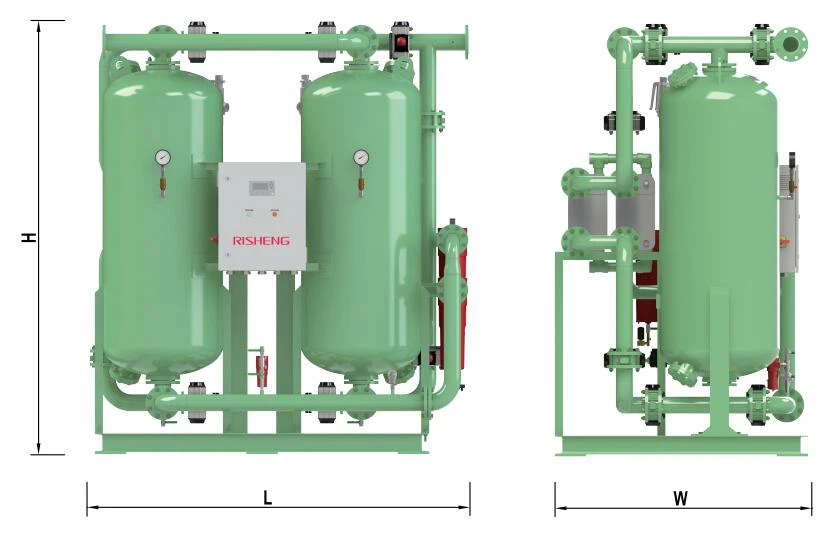
| Model | Capacity | Connections | Water | Dimension mm | Weight | Recommended | ||||
| m³/min | CFM | Air | Water | Consumption t/h | L | W | H | kg | After-Filter Model | |
| RSXY-60ZP | 6 | 212 | DN50 | 2" | 6.1 | 2000 | 900 | 1900 | 1000 | RSG-AR-0145G/V2 |
| RSXY-80ZP | 8 | 282 | DN50 | 2" | 8.2 | 2000 | 900 | 1900 | 1050 | RSG-AR-0145G/V2 |
| RSXY-100ZP | 10 | 353 | DN50 | 2" | 10.2 | 2066 | 950 | 1916 | 1151 | RSG-AR-0220G/V2 |
| RSXY-120ZP | 12 | 424 | DN50 | 2" | 12.2 | 2066 | 1000 | 2000 | 1250 | RSG-AR-0220G/V2 |
| RSXY-150ZP | 15 | 530 | DN65 | 2" | 15.3 | 2165 | 1000 | 2316 | 1550 | RSG-AR-0330G/V2 |
| RSXY-200ZP | 20 | 706 | DN65 | 2" | 20.4 | 2225 | 1000 | 2567 | 1640 | RSG-AR-0330G/V2 |
| RSXY-220ZP | 22 | 777 | DN65 | 2" | 22.4 | 2325 | 1050 | 2647 | 1900 | RSG-AR-0430G/V2 |
| RSXY-250ZP | 25 | 883 | DN65 | 2" | 25.5 | 2325 | 1050 | 2647 | 1980 | RSG-AR-0430G/V2 |
| RSXY-350ZP | 35 | 1236 | DN80 | 2" | 35.7 | 2452 | 1250 | 2510 | 2470 | RSG-AR-0620G/V2 |
| RSXY-450ZP | 45 | 1589 | DN100 | 3" | 45.9 | 2900 | 1400 | 2690 | 3000 | RSG-AR-0830F/V2 |
| RSXY-600ZP | 60 | 2119 | DN100 | 3" | 61.2 | 3100 | 1650 | 2717 | 3800 | RSG-AR-1000F/V2 |
|
Rated Conditions |
Working Range |
Avaliable |
 |
|
Working pressure : 0.7MPag / 100psig |
Max.working pressure : 1.0MPag / 145psig |
Higher pressure above 1.0Mpag / 145psig |
|
|
Inlet temp : 160 ℃ / 320 ℉ |
Max.inlet temp : 200℃ / 394 ℉ |
Booster heater |
|
|
Cooling water temp : 32℃ / 90 ℉ |
Max.ambient temperature : 40℃ / 104 ℉ |
Higher capacity |
|
|
Stainless steel vessel or piping |
|||
|
GB,ASME,PED,etc. vessels |
|||
|
Zero loss drain |
Applications
Pharmaceutical Manufacturing: In the pharmaceutical industry, moisture in compressed air can lead to contamination and compromised product quality. A desiccant dryer ensures the air used in production is dry and sterile.
Food and Beverage Processing: Dry, clean air is essential to avoid contamination in packaging, bottling, and other food production processes.
Electronics and Semiconductor Manufacturing: These industries require extremely dry air to prevent short circuits or damage to sensitive components during production.
Petrochemical Industry: Compressed air in the petrochemical industry is often exposed to high levels of moisture. A desiccant dryer helps prevent the formation of dangerous hydrocarbon-based sludges in pipelines and machinery.
Correction Factors
Actual Capacity (m³/min) = Nominal Capacity × KA × KB
| Working Pressure (KA) | Mpag | 0.5 | 0.6 | 0.7 | 0.8 | 0.9 | 1 |
| psig | 73 | 87 | 100 | 116 | 131 | 145 | |
| CFP | 0.75 | 0.87 | 1 | 1.13 | 1.25 | 1.37 |
| Cooling Water Temperature (KB) | ℃ | 25 | 30 | 32 | 35 |
| ℉ | 77 | 86 | 90 | 95 | |
| CFT | 1.33 | 1.11 | 1 | 0.85 |
FAQ:
1: What is the purpose of a desiccant dryer in a compressed air system?
The primary purpose of a desiccant dryer is to remove moisture from compressed air. This prevents the formation of condensation, which can lead to corrosion, equipment damage, and contamination of the production process. By ensuring the air is dry, the dryer helps maintain the reliability and efficiency of air-powered systems.
2: What industries benefit most from using a compressor desiccant dryer?
Industries such as pharmaceuticals, food and beverage, petrochemicals, electronics, and automotive manufacturing benefit the most. These sectors require high-purity, moisture-free compressed air to maintain product quality, ensure safety, and avoid equipment malfunctions due to moisture buildup.
3: How does a heatless desiccant dryer differ from a heated desiccant dryer?
In a heatless desiccant dryer, regeneration of the desiccant material is done by redirecting a portion of the dried air back through the saturated desiccant bed, whereas a heated desiccant dryer uses external heat for regeneration. Heatless dryers are more energy-efficient but may result in a small loss of compressed air, while heated dryers allow for full use of compressed air but consume more energy.
4: What dew point can a desiccant dryer typically achieve?
A desiccant dryer can achieve a dew point as low as -40°F (-40°C), with some advanced models capable of reaching dew points as low as -100°F (-73°C). The lower the dew point, the drier the air, which is essential in moisture-sensitive applications such as electronics manufacturing and pharmaceuticals.
5: How often does the desiccant material need to be replaced?
The frequency of replacing the desiccant material depends on the usage and the type of air being treated. Under normal conditions and with proper regeneration, the desiccant can last several years. However, in environments with heavy moisture loads or contaminants, more frequent replacement may be necessary.
6: What maintenance is required for desiccant dryer?
Regular maintenance includes monitoring the dew point, checking the pressure drop across the dryer, and ensuring the desiccant material is properly regenerated. Periodic inspections of the dryer components, including valves, filters, and the desiccant itself, are recommended to ensure optimal performance and longevity.


