


Key Features and Advantages
Effective Moisture Removal: Desiccant dryers are capable of producing extremely dry air with a dew point as low as -40°C to -70°C, which is essential for industries requiring high levels of moisture control.
Continuous Operation: The dual-tower system allows one tower to dry the air while the other regenerates, ensuring an uninterrupted supply of dry compressed air.
Flexibility: Desiccant dryers are available in various sizes and configurations, making them suitable for a wide range of applications, from small-scale operations to large industrial setups.
Energy-Efficient Options: While heated desiccant dryers consume more energy due to the heating element, heatless models offer energy savings by eliminating the need for external heat, though at the cost of sacrificing a small amount of dried air.
Protects Equipment and Products: By removing moisture, desiccant dryers prevent corrosion and rust in pneumatic equipment, as well as contamination or spoilage in sensitive manufacturing processes.
Compact and Modular Designs: Desiccant dryers are often designed with compact footprints, allowing for easy installation even in space-constrained environments. Modular designs also enable customization based on airflow requirements.
Technical Specification
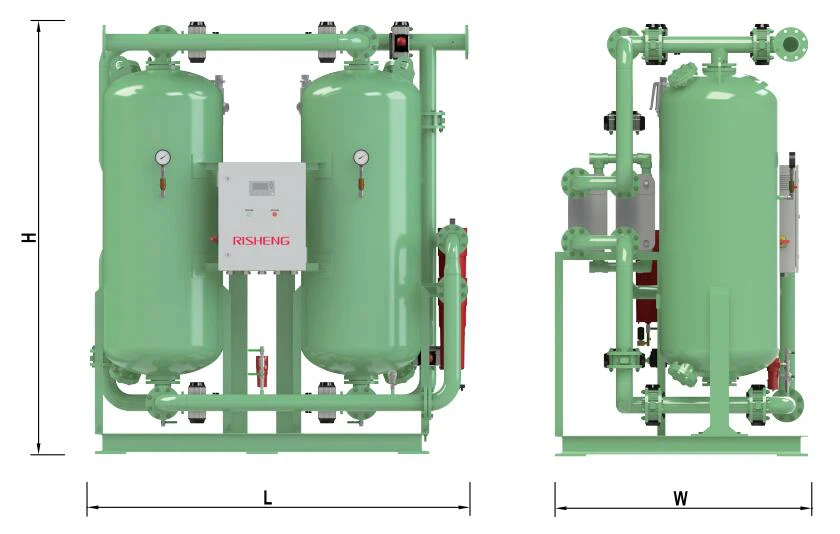
| Model | Capacity | Connections | Water | Dimension mm | Weight | Recommended | ||||
| m³/min | CFM | Air | Water | Consumption t/h | L | W | H | kg | After-Filter Model | |
| RSXY-60ZP | 6 | 212 | DN50 | 2" | 6.1 | 2000 | 900 | 1900 | 1000 | RSG-AR-0145G/V2 |
| RSXY-80ZP | 8 | 282 | DN50 | 2" | 8.2 | 2000 | 900 | 1900 | 1050 | RSG-AR-0145G/V2 |
| RSXY-100ZP | 10 | 353 | DN50 | 2" | 10.2 | 2066 | 950 | 1916 | 1151 | RSG-AR-0220G/V2 |
| RSXY-120ZP | 12 | 424 | DN50 | 2" | 12.2 | 2066 | 1000 | 2000 | 1250 | RSG-AR-0220G/V2 |
| RSXY-150ZP | 15 | 530 | DN65 | 2" | 15.3 | 2165 | 1000 | 2316 | 1550 | RSG-AR-0330G/V2 |
| RSXY-200ZP | 20 | 706 | DN65 | 2" | 20.4 | 2225 | 1000 | 2567 | 1640 | RSG-AR-0330G/V2 |
| RSXY-220ZP | 22 | 777 | DN65 | 2" | 22.4 | 2325 | 1050 | 2647 | 1900 | RSG-AR-0430G/V2 |
| RSXY-250ZP | 25 | 883 | DN65 | 2" | 25.5 | 2325 | 1050 | 2647 | 1980 | RSG-AR-0430G/V2 |
| RSXY-350ZP | 35 | 1236 | DN80 | 2" | 35.7 | 2452 | 1250 | 2510 | 2470 | RSG-AR-0620G/V2 |
| RSXY-450ZP | 45 | 1589 | DN100 | 3" | 45.9 | 2900 | 1400 | 2690 | 3000 | RSG-AR-0830F/V2 |
| RSXY-600ZP | 60 | 2119 | DN100 | 3" | 61.2 | 3100 | 1650 | 2717 | 3800 | RSG-AR-1000F/V2 |
|
Rated Conditions |
Working Range |
Avaliable |
 |
|
Working pressure : 0.7MPag / 100psig |
Max.working pressure : 1.0MPag / 145psig |
Higher pressure above 1.0Mpag / 145psig |
|
|
Inlet temp : 160 ℃ / 320 ℉ |
Max.inlet temp : 200℃ / 394 ℉ |
Booster heater |
|
|
Cooling water temp : 32℃ / 90 ℉ |
Max.ambient temperature : 40℃ / 104 ℉ |
Higher capacity |
|
|
Stainless steel vessel or piping |
|||
|
GB,ASME,PED,etc. vessels |
|||
|
Zero loss drain |
Correction Factors
Actual Capacity (m³/min) = Nominal Capacity × KA × KB
| Working Pressure (KA) | Mpag | 0.5 | 0.6 | 0.7 | 0.8 | 0.9 | 1 |
| psig | 73 | 87 | 100 | 116 | 131 | 145 | |
| CFP | 0.75 | 0.87 | 1 | 1.13 | 1.25 | 1.37 |
| Cooling Water Temperature (KB) | ℃ | 25 | 30 | 32 | 35 |
| ℉ | 77 | 86 | 90 | 95 | |
| CFT | 1.33 | 1.11 | 1 | 0.85 |
FAQ
1. What dew point can a desiccant dryer achieve?
Desiccant dryers can achieve dew points as low as -40°C to -70°C, depending on the model and application. This makes them ideal for industries requiring extremely dry air, such as electronics, pharmaceuticals, and food production.
2. What are the main differences between a heatless and heated desiccant dryer?
A heatless desiccant dryer regenerates the desiccant using a portion of the dried compressed air, making it more energy-efficient but with slightly lower efficiency due to air loss. A heated desiccant dryer, on the other hand, uses an external heat source for regeneration, preserving more compressed air but consuming more energy.
3. How often should the desiccant be replaced?
The desiccant in a desiccant dryer typically lasts between 3 to 5 years, depending on usage conditions, air quality, and maintenance practices. Regular monitoring and replacement are important to ensure the dryer's effectiveness and efficiency.
4. Is a desiccant dryer suitable for high-flow compressed air systems?
Yes, desiccant dryers come in a range of capacities to suit both low-flow and high-flow systems. Larger models with high air throughput are available for industrial environments requiring significant amounts of dry compressed air.
5. What is the energy consumption of a desiccant dryer?
The energy consumption of a desiccant dryer depends on the type. Heatless dryers are generally more energy-efficient as they don't require external heat, but they use a portion of the dried air for regeneration. Heated dryers use more energy due to the heating element, but they are more efficient in terms of air preservation.
6. What maintenance is required for a desiccant dryer?
Regular maintenance includes inspecting and replacing the desiccant every 3 to 5 years, checking and cleaning the air filters, and ensuring that the valves and seals are functioning properly. Regular monitoring of dew points is also essential to ensure optimal performance.


