

In today's highly automated and sophisticated industrial production process, compressed air, as the "fourth largest energy source of industry", is widely used in many fields such as mechanical processing, food packaging, and electronic chip manufacturing. However, untreated compressed air often contains a large amount of moisture, which not only causes equipment corrosion and pneumatic component failure, but also seriously affects product quality, becoming an "invisible killer" of industrial production. Adsorption air dryers have become key equipment for industrial air source purification due to their efficient and stable drying performance. Their unique working method is constantly promoting the improvement of production standards in various industries and has attracted much attention from the market.
Table of contents
●Core structure: Hardware foundation for efficient work
(1.) Drying tower: Main battlefield for adsorption and regeneration
(2.) Valve system: Precise control hub for airflow
(3.) Control system: "brain" for intelligent operation
●Workflow: Precision cycle for moisture removal
(1.) Adsorption phase: Efficient retention of moisture
(2.) Regeneration phase: "rebirth" of adsorbent
(3.) Pressure equalization phase: Key link for smooth transition
●Significant advantages: Core competitiveness for industrial applications
(1.) Efficient drying to meet stringent requirements
(2.) Energy saving and consumption reduction to reduce operating costs
(3.) Stable and reliable to reduce maintenance troubles
●Industry application: Deep penetration in multiple fields
(1.) Machinery manufacturing: "protective shield" for equipment and "booster" for production
(2.) Food and beverage: "guardian" of food safety
(3.) Electronic semiconductors: "escort" of precision processes
●Market dynamics and future prospects
Core structure: the hardware foundation supporting efficient work
Drying tower: the main battlefield of adsorption and regeneration
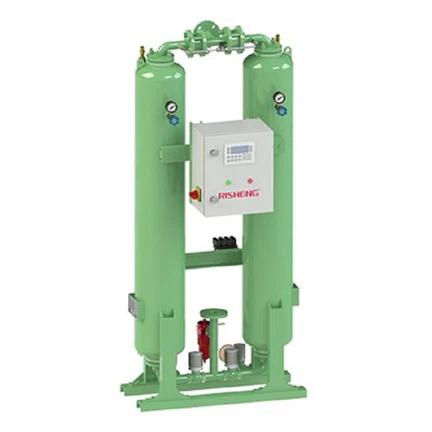
The core component of the Heated Blower Adsorption Air Dryer is the drying tower, which is usually a double-tower or multi-tower structure. The adsorbents such as activated alumina and molecular sieve filled in the tower are the core materials for achieving moisture removal. Taking molecular sieve as an example, its internal microporous structure is like a precise molecular "sieve", which can selectively adsorb moisture according to the size of the molecule, and has a huge specific surface area. The surface area of each gram of molecular sieve can reach hundreds or even thousands of square meters, which greatly improves the adsorption efficiency. The drying tower is made of high-strength corrosion-resistant materials to ensure stable operation under high pressure and complex working conditions, and provide a reliable physical space for the adsorption and regeneration process.
Valve system: the hub for precise control of airflow
The valve system plays the role of "traffic police" in the adsorption air dryer. Various valves such as the inlet valve, outlet valve, regeneration valve, and equalizing valve work together to accurately control the direction and flow of airflow through the instructions of the automatic control system. During the adsorption stage, the air inlet valve and the air outlet valve are opened to guide the compressed air into the drying tower in an orderly manner for drying; during the regeneration stage, the regeneration valve is opened to allow part of the dried air to enter the regeneration tower in reverse to complete the regeneration of the adsorbent. The precise opening and closing and adjustment of the valves during the whole process ensure the reasonable flow direction of the airflow and the stable operation of the dryer.
Control system: the "brain" of intelligent operation
Modern adsorption air dryers are equipped with advanced control systems, mostly using programmable logic controllers (PLCs) or intelligent control modules. The system can monitor key operating parameters such as inlet pressure, temperature, and outlet dew point in real time, and automatically control the working status of the drying tower and valve switching according to preset programs. Some high-end products are also equipped with remote monitoring and fault diagnosis functions. Operators can remotely view equipment operation data and receive fault warning information through mobile phones or computers, realize intelligent management of equipment, and significantly improve the reliability and management efficiency of equipment operation.
Workflow: Precision cycle of moisture removal
Adsorption stage: Efficient retention of moisture
When compressed air enters the adsorption air dryer, it first passes through the pre-filter to remove solid particles, oil mist and other impurities, providing a relatively clean air source for the subsequent drying process. Then, the clean compressed air enters the drying tower in the adsorption state and passes through the adsorbent bed from bottom to top. In this process, the adsorbent firmly adsorbs the water vapor molecules in the compressed air on its surface with its strong adsorption force, achieving efficient retention of moisture. The dry compressed air after adsorption treatment is further purified by the post-filter and finally output to the gas user, meeting the strict requirements of industrial production for dry air sources.
Regeneration stage: the "rebirth" journey of the adsorbent
In order for the adsorbent to continue to play a role, the adsorbent saturated with adsorption needs to be regenerated. The adsorption air dryer mainly adopts two regeneration methods: pressure swing adsorption (PSA) and micro-thermal adsorption (TSA). During the pressure swing adsorption regeneration process, when the adsorbent of a drying tower reaches saturation, the tower enters the regeneration stage. The system decompresses part of the dried compressed air to near atmospheric pressure, and the decompressed air is reversely passed into the tower. Due to the pressure reduction, the water molecules originally adsorbed on the surface of the adsorbent obtain enough energy to desorb from the surface of the adsorbent and are discharged from the system with the decompressed airflow, thereby restoring the adsorption capacity of the adsorbent.
The micro-thermal adsorption regeneration method slightly heats the regeneration gas on the basis of pressure swing. The heated regeneration gas can more efficiently remove the moisture in the adsorbent. Compared with simple pressure swing adsorption regeneration, micro-thermal adsorption regeneration can make the adsorbent regeneration more thorough, effectively extend the service life of the adsorbent, and improve the overall performance of the dryer.
Equalizing pressure stage: the key link for smooth transition
When switching between the adsorption tower and the regeneration tower, the equalizing pressure stage plays an important role. The purpose of equalizing pressure is to balance the pressure of the regeneration tower that is about to be put into adsorption work with the system pressure, avoid airflow shock due to excessive pressure difference, and protect the stability of equipment operation and the service life of the adsorbent. Through the control of the equalizing pressure valve, the gas between the two towers circulates slowly to achieve a smooth transition of pressure, fully prepare for the next stage of adsorption work, and ensure the continuity and stability of the dryer operation.
Significant advantages: Core competitiveness of industrial applications
Efficient drying to meet stringent requirements
Heatless Adsorption Air Dryer can significantly reduce the dew point temperature of compressed air, and some high-end equipment can even reach -70℃, far exceeding the performance of other types of drying equipment. This efficient drying capacity can meet the needs of industries such as electronic semiconductors, medical and pharmaceutical industries that have extremely high requirements for air source dryness, provide reliable guarantees for precision production processes, and effectively avoid product quality problems and equipment failures caused by moisture.
Energy saving and consumption reduction, reduce operating costs
Compared with drying equipment that requires continuous heating, during the regeneration process of the adsorption air dryer, the pressure swing adsorption method does not require additional heat energy, and the micro-heat adsorption method only requires a small amount of heat energy assistance, which significantly reduces energy consumption. Taking a large machinery manufacturing enterprise as an example, after adopting the adsorption air dryer, the annual energy consumption cost in the air source drying link was reduced by 35%, greatly reducing the operating burden of the enterprise.
Stable and reliable, reducing maintenance troubles
Due to the reasonable design of the core structure and the long service life of the adsorbent of the main components (usually up to 3-5 years), the adsorption air dryer has a long maintenance cycle and a small maintenance workload. Daily maintenance mainly focuses on simple operations such as regularly checking valve status, replacing filter elements, and replacing adsorbents in a timely manner, which effectively reduces equipment downtime, ensures the continuity of industrial production, and reduces production losses caused by equipment maintenance.
Industry application: Deep penetration in multiple fields
Mechanical manufacturing: "protective shield" of equipment and "booster" of production
In the mechanical manufacturing industry, compressed air is often used to drive pneumatic tools and control automated production lines. Adsorption air dryers provide dry air sources for them, effectively preventing equipment from being damaged by moisture corrosion, extending the service life of equipment, and reducing equipment maintenance costs. At the same time, dry compressed air makes pneumatic components run more stably, improves processing accuracy and production efficiency, and helps mechanical manufacturing companies improve product quality and market competitiveness.
Food and beverage: "guardian" of food safety
The food and beverage industry has extremely high requirements for the cleanliness of compressed air. The presence of moisture may breed bacteria and contaminate food. Adsorption air dryers are used in conjunction with sterilization and dust removal equipment to provide dry and sterile compressed air for food packaging, filling and other links, ensuring food safety from the source. For example, in the process of beverage filling, dry compressed air is used for bottle cleaning, bottle cap pressing and sealing operations to avoid microbial contamination and packaging damage caused by moisture, and ensure that food and beverage products meet strict hygiene standards.
Electronic semiconductors: the "escort" of precision manufacturing processes
Electronic semiconductor manufacturing involves precision processes such as photolithography, etching, and packaging, which have very strict requirements on the dryness and purity of compressed air. With its excellent drying performance, the adsorption air dryer controls the dew point temperature of compressed air at an extremely low level, effectively preventing moisture from causing short circuits, oxidation and other damages to precision electronic components such as chips and circuit boards, ensuring product yield and promoting the electronic semiconductor industry to develop in the direction of higher precision and higher performance.
Market dynamics and future prospects
The market scale continues to expand
With the acceleration of global industrialization and the continuous improvement of air quality requirements in various industries, the market scale of adsorption air dryers has shown a steady growth trend. According to market research institutions, the global adsorption air dryer market will have an annual compound growth rate of 8% - 10% in the next five years. Emerging economies such as China and India will continue to increase their demand for adsorption air dryers with the rapid development of manufacturing.
Technological innovation leads development
In order to meet the market demand for efficient, energy-saving and intelligent equipment, major manufacturers have increased their R&D investment to promote the continuous innovation of adsorption air dryer technology. The research and development of new adsorbents has become a hot topic, such as composite adsorbents with higher adsorption capacity and selectivity are gradually put into use; intelligent control systems are further upgraded to achieve adaptive adjustment of equipment operating parameters and intelligent diagnosis of faults; equipment integrated design is continuously optimized to make the product smaller and more convenient to install, and adapt to more complex industrial scenarios.
Green and environmental protection has become a new trend
In the context of global advocacy of green development, adsorption air dryers will pay more attention to energy conservation and environmental protection in the future. On the one hand, by optimizing the regeneration process and equipment structure, energy consumption can be further reduced; on the other hand, recyclable and reusable adsorbent materials can be developed to reduce the impact on the environment, achieve greening of the entire product life cycle, and promote sustainable development of the industry.