

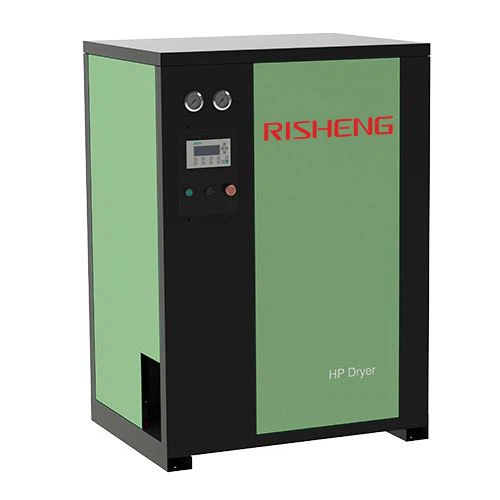
Product specification
In some electronic chip manufacturing workshops that are extremely sensitive to humidity, nano air dryers can reduce air humidity to extremely low levels, ensuring that short circuits, corrosion and other faults will not occur due to water vapor problems during the chip production process, effectively improving product yield.
|
Rated Conditions |
|
|
Working pressure : 0.7MPag / 100psig |
|
|
Inlet temp : 38 ℃ / 100 ℉ |
|
|
Ambient temp : 38℃ / 100 ℉ |
|
|
Working Range |
|
|
Max. working pressure : 1.6MPag / 232psig |
|
|
Max. inlet temperature : 60 ℃ / 140 ℉ |
|
|
Max. ambient temperature : 50℃ / 122 ℉ |
|
|
Min. ambient temperature : 5℃ / 41 ℉ |
|
|
Avaliable |
|
|
Higher working pressure |
|
|
Different power supply |
|
|
Timed drain or zero loss drain |

Products Certificate
Our Products Have Passed Various Certifications


Product Application
Industrial production field: In the chemical industry, many chemical reactions are extremely sensitive to environmental humidity. Nano air dryers provide dry air for the reaction process to prevent moisture from interfering with chemical reactions and improve product purity and yield. In petroleum refining, dry air is used to drive equipment and purify process gases. Nano air dryers can effectively remove moisture from the air, avoid equipment corrosion and pipeline blockage, and ensure safe and stable production operation. In the textile industry, nano air dryers can control the air humidity in the workshop, prevent yarn from being deformed by moisture, and improve the quality and production efficiency of textiles. For example, in the production process of high-end silk fabrics, precise humidity control can ensure the gloss and softness of silk and improve product quality.
Electronics and precision manufacturing industry: Electronic chip manufacturing has almost harsh requirements on air humidity. The ultra-dry air provided by nano air dryers is used in the air circulation system of the chip manufacturing workshop, as well as key process links such as lithography, etching, and packaging, effectively preventing chips from short circuiting and performance degradation due to moisture, and ensuring high performance and high reliability of chips. In the field of precision instrument manufacturing, such as optical instruments and medical devices, nano air dryers ensure that the air in the production environment and inside the equipment is dry, avoid rust and mold on instrument parts, and ensure the accuracy and service life of the instrument.
Food and pharmaceutical industry: In the process of food processing, nano air dryers are used to dry the air used for packaging to prevent food from getting damp and deteriorating, and extend the shelf life of food. In the packaging process of baked goods, potato chips, nuts and other products, dry air can maintain the crisp taste and freshness of food. In the field of pharmaceutical production, drugs have strict requirements on environmental humidity. Nano air dryers provide dry and clean air for pharmaceutical production workshops to meet the strict requirements of pharmaceutical production on environmental humidity, ensure that the quality of drugs meets the standards, and ensure the safety of patients' medication.
Daily life scenarios: In the home, nano air dryers can be used to improve indoor air quality, especially in humid seasons or areas. They can effectively reduce indoor humidity, reduce mold growth, prevent furniture and clothing from getting damp and moldy, and create a comfortable and healthy living environment for family members. In the central air conditioning system of some high-end residences, nano air dryers are equipped to deeply dry and purify indoor air to improve living comfort. In commercial places, such as hotels, shopping malls, libraries, etc., nano air dryers can be used to adjust indoor humidity and provide a comfortable environment for customers and employees.
Other fields: In the automobile manufacturing industry, nano air dryers are used in automobile painting processes. Dry air can ensure uniform and smooth painting, improve the adhesion and aesthetics of the paint. In the production process of automobile parts, such as engine manufacturing, dry air is also used for equipment operation and parts cleaning to prevent water vapor from corroding precision parts. In the laboratory, nano air dryers provide dry air sources for various experimental equipment to ensure the accuracy of experimental results.
FAQ
Q: How effectively does it remove moisture from the air in our industrial environment?
A: It removes moisture from the air extremely effectively, even in complex industrial environments. Utilizing advanced nano - technology, it can achieve very low dew - points. The nano - scale materials or mechanisms within it enhance the surface area for moisture adsorption. For example, in a manufacturing facility with high humidity levels due to processes like painting or chemical reactions, it can reduce the relative humidity to levels suitable for equipment operation and product quality control. It can trap and hold water vapor molecules efficiently, ensuring that the air is dry enough to prevent issues such as corrosion of machinery and degradation of sensitive materials.
Q: What is the maintenance requirement for it, and how much time and cost will it involve?
A: The maintenance requirement for it is relatively low. Regularly, you may need to clean or replace certain nano - filter components. The frequency depends on the operating conditions, but typically, it could be every few months. Cleaning can often be done on - site with simple tools, and replacement parts are usually reasonably priced. Since it has a compact and efficient design with fewer complex moving parts compared to some traditional air dryers, the maintenance time is minimal.
Q: How easy is it to install in our existing air handling systems?
A: It is quite easy to install in your existing air handling systems. It is designed to be modular and can be integrated into most standard air ducts or ventilation setups. The unit usually comes with clear installation instructions and pre - configured connection points. In most cases, with the help of a qualified technician, it can be installed within a few hours. There may be some minor adjustments to the air flow direction or duct sizing, but overall, the installation process is straightforward. This ease of installation allows you to quickly upgrade your air drying capabilities without significant downtime for your air handling systems.
Q: How energy - efficient is it, and what impact will it have on our utility bills?
A: It is highly energy - efficient. The nano - technology - based operation reduces the need for high - power consumption processes like heating or cooling for moisture removal. It often uses less energy compared to traditional air drying methods. In a large - scale industrial operation where air drying is a continuous process, the cumulative energy savings over time can be substantial. This directly translates to lower utility bills. For example, if your facility runs multiple air dryers around the clock, switching to a nano air dryer can lead to a significant reduction in your monthly electricity costs, making it a cost - effective choice for long - term operation.
Q: Can it be customized to meet the specific air quality and volume requirements of our unique industrial processes?
A: Yes, it can be customized to meet the specific air quality and volume requirements of your unique industrial processes. Manufacturers can adjust the design, such as the type and quantity of nano - materials used, the air flow rate capacity, and the control systems. If your industrial process requires extremely dry air with a particular dew - point target or has a high - volume air - drying demand, the nano air dryer can be tailored accordingly. This customization ensures that it is optimized for your specific industrial needs, providing the best possible performance and efficiency for your operations.


