


Advantages
Superior Moisture Removal:They are highly effective at removing even the smallest traces of moisture, achieving dew points well below freezing. This makes them ideal for industries such as food and beverage, pharmaceuticals, and electronics, where ultra-dry air is essential.
Energy Savings: The use of external heat to regenerate the desiccant material reduces the amount of compressed air used in the process, resulting in significant energy savings. This is particularly beneficial for applications with high air flow rates.
Extended Desiccant Life: By using heat during regeneration, the desiccant material undergoes less stress, leading to a longer lifespan compared to systems that rely solely on air purging for regeneration.
Reduced Purge Air Loss: Heated desiccant dryers require significantly less purge air compared to heatless dryers. This allows more compressed air to be available for productive use, enhancing overall system efficiency.
Consistent Air Quality: Heated desiccant dryers provide a continuous supply of dry air, ensuring that the quality of the compressed air is consistent and meets the stringent requirements of sensitive applications.
Technical Specification
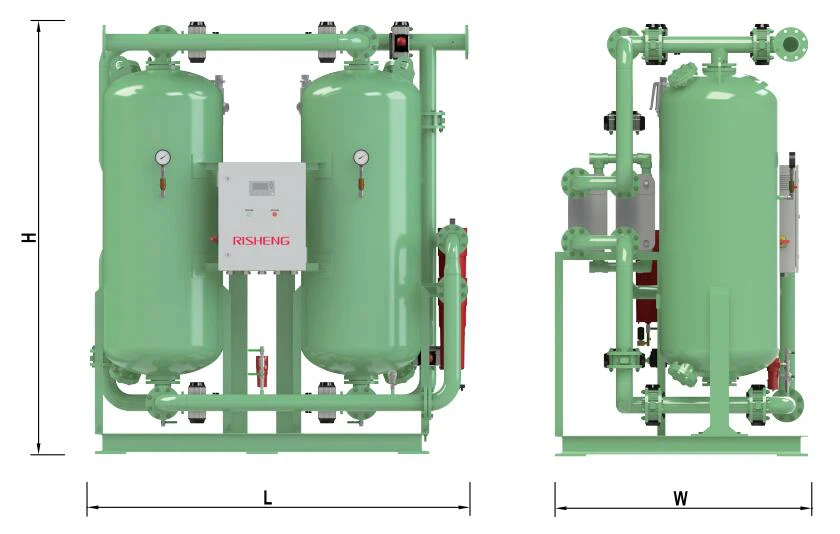
| Model | Capacity | Connections | Water | Dimension mm | Weight | Recommended | ||||
| m³/min | CFM | Air | Water | Consumption t/h | L | W | H | kg | After-Filter Model | |
| RSXY-60ZP | 6 | 212 | DN50 | 2" | 6.1 | 2000 | 900 | 1900 | 1000 | RSG-AR-0145G/V2 |
| RSXY-80ZP | 8 | 282 | DN50 | 2" | 8.2 | 2000 | 900 | 1900 | 1050 | RSG-AR-0145G/V2 |
| RSXY-100ZP | 10 | 353 | DN50 | 2" | 10.2 | 2066 | 950 | 1916 | 1151 | RSG-AR-0220G/V2 |
| RSXY-120ZP | 12 | 424 | DN50 | 2" | 12.2 | 2066 | 1000 | 2000 | 1250 | RSG-AR-0220G/V2 |
| RSXY-150ZP | 15 | 530 | DN65 | 2" | 15.3 | 2165 | 1000 | 2316 | 1550 | RSG-AR-0330G/V2 |
| RSXY-200ZP | 20 | 706 | DN65 | 2" | 20.4 | 2225 | 1000 | 2567 | 1640 | RSG-AR-0330G/V2 |
| RSXY-220ZP | 22 | 777 | DN65 | 2" | 22.4 | 2325 | 1050 | 2647 | 1900 | RSG-AR-0430G/V2 |
| RSXY-250ZP | 25 | 883 | DN65 | 2" | 25.5 | 2325 | 1050 | 2647 | 1980 | RSG-AR-0430G/V2 |
| RSXY-350ZP | 35 | 1236 | DN80 | 2" | 35.7 | 2452 | 1250 | 2510 | 2470 | RSG-AR-0620G/V2 |
| RSXY-450ZP | 45 | 1589 | DN100 | 3" | 45.9 | 2900 | 1400 | 2690 | 3000 | RSG-AR-0830F/V2 |
| RSXY-600ZP | 60 | 2119 | DN100 | 3" | 61.2 | 3100 | 1650 | 2717 | 3800 | RSG-AR-1000F/V2 |
|
Rated Conditions |
Working Range |
Avaliable |
 |
|
Working pressure : 0.7MPag / 100psig |
Max.working pressure : 1.0MPag / 145psig |
Higher pressure above 1.0Mpag / 145psig |
|
|
Inlet temp : 160 ℃ / 320 ℉ |
Max.inlet temp : 200℃ / 394 ℉ |
Booster heater |
|
|
Cooling water temp : 32℃ / 90 ℉ |
Max.ambient temperature : 40℃ / 104 ℉ |
Higher capacity |
|
|
Stainless steel vessel or piping |
|||
|
GB,ASME,PED,etc. vessels |
|||
|
Zero loss drain |
Correction Factors
Actual Capacity (m³/min) = Nominal Capacity × KA × KB
| Working Pressure (KA) | Mpag | 0.5 | 0.6 | 0.7 | 0.8 | 0.9 | 1 |
| psig | 73 | 87 | 100 | 116 | 131 | 145 | |
| CFP | 0.75 | 0.87 | 1 | 1.13 | 1.25 | 1.37 |
| Cooling Water Temperature (KB) | ℃ | 25 | 30 | 32 | 35 |
| ℉ | 77 | 86 | 90 | 95 | |
| CFT | 1.33 | 1.11 | 1 | 0.85 |
FAQ
1.Why are heated desiccant dryers considered highly effective for moisture removal?
Heated desiccant dryers achieve superior moisture removal by reaching dew points well below freezing. This ensures that even the smallest traces of moisture are eliminated, making them ideal for industries such as food and beverage, pharmaceuticals, and electronics, where ultra-dry air is critical for product quality and equipment performance.
2.How do heated desiccant dryers contribute to energy savings?
Heated desiccant dryers use external heat to regenerate the desiccant material, which significantly reduces the amount of compressed air needed for regeneration. This leads to considerable energy savings, especially in applications with high air flow rates, making the system more cost-effective.
3.What impact does heat have on the lifespan of the desiccant material in heated desiccant dryers?
By using heat during the regeneration process, the desiccant material in heated dryers experiences less stress compared to systems that rely solely on air purging. This extends the desiccant's lifespan, reducing maintenance costs and improving overall system longevity.
4.Why is reduced purge air loss important in heated desiccant dryers?
Heated desiccant dryers require less purge air compared to heatless dryers, allowing more compressed air to be available for productive use. This reduces waste and improves overall system efficiency, making it a more practical solution for energy-conscious industries.
5.How do heated desiccant dryers ensure consistent air quality?
Heated desiccant dryers provide a continuous supply of dry, moisture-free air, ensuring that the compressed air quality remains consistent. This is crucial for sensitive applications in industries such as pharmaceuticals, electronics, and food processing, where moisture can compromise the integrity of the product or equipment.
6.What industries benefit most from using heated desiccant dryers?
Industries such as food and beverage, pharmaceuticals, electronics, chemical processing, and automotive manufacturing benefit from heated desiccant dryers. These industries require extremely dry, high-quality compressed air to maintain product standards, prevent contamination, and protect sensitive equipment from moisture-related issues.


