

When discussing the food and beverage industry, one might immediately think of raw materials, formulas, and packaging processes. Yet, in modern factories, many of these stages rely on an "invisible force": compressed air.
Often referred to as the "fourth utility" of industry-ranking just behind water, electricity, and gas-compressed air is indispensable to food and beverage production. From bottle blow molding and beverage filling to packaging film sealing, almost every detail depends on it.
**The Critical Role of Compressed Air in the Food Industry**
Standards for food-grade air are far more rigorous than those for general industrial applications:
* **Must be clean:** Any oil mist, dust, or impurities entering the production line can directly contaminate the food.
* **Must be dry:** Humid air can compromise packaging seals or foster bacterial growth in pipelines.
* **Must be stable:** Fluctuations in air pressure can cause loose bottle caps or production line stoppages, leading to anything from rework to the scrapping of entire batches.
To illustrate with everyday examples:
* If you open a bottle of soda and find the cap loose or the drink flat, the culprit is likely unstable compressed air quality during the filling process.
* If a yogurt cup's seal leaks, it is often because moisture in the air caused the sealing process to fail.
This is why the industry often says: "Without clean, stable compressed air, there is no safe food production."
**Why Do Major Global Brands Prioritize Air Purification?**
Take companies like Nestlé, Coca-Cola, and Classy Kiss (Cas) as examples; their investment in air purification is nothing short of exacting.
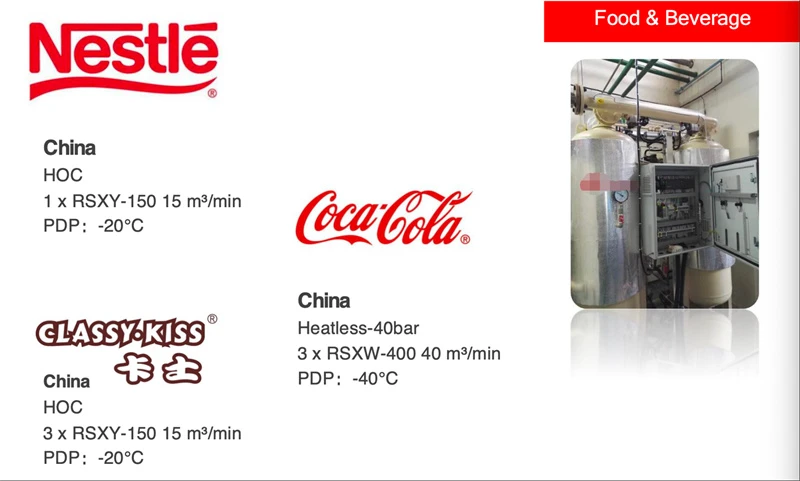
**Risheng Customers and Equipment**
* **Nestlé China:** Uses the RSXY-150 adsorption dryer on its production lines. Each unit handles a flow rate of 15 m³/min and achieves a pressure dew point of -20°C. This ensures that no moisture condenses out of the air even at temperatures as low as -20°C, guaranteeing dryness throughout the entire production process.
* **Coca-Cola:** Employs the RSXW-400 heatless regenerative adsorption dryer. Each unit boasts a processing capacity of up to 40 m³/min, operates at a high pressure of 40 bar, and achieves a pressure dew point of -40°C. This configuration ensures that the air supply remains consistently pure and stable on high-speed carbonated beverage filling lines, preventing fluctuations from compromising product quality.
Classy Kiss (Ka Shi): Also opted for adsorption dryers with a pressure dew point requirement of -20°C. This guarantees dry, moisture-free air during food packaging, thereby preventing bacterial growth.
You might ask: Why do these major international brands invest so heavily? Because an air quality issue doesn't just affect one or two bottles-it impacts an entire batch of products and could even trigger a widespread food safety crisis. They cannot afford to fail in this regard, nor can they accept the severe damage to their brand reputation that would ensue.
Three Key Aspects of Compressed Air Purification
Whether they are international giants or local food enterprises, companies must focus on three core elements of compressed air:
Drying: Lowering the dew point to prevent moisture condensation, corrosion, and microbial growth.
Filtration: Removing oil mist and solid particles to ensure the air truly meets "food-grade" standards.
Stability: Maintaining constant pressure and flow to prevent production line downtime caused by fluctuations.
This is why an increasing number of companies are proactively upgrading their purification equipment, shifting from a "good enough to use" mindset to one that demands "high standards"-because food safety and brand reputation are the non-negotiable bottom line.
Companies like Nestlé and Coca-Cola spare no expense on compressed air purification not simply because they have money to burn, but because they fully understand that compressed air acts as the invisible guardian of food safety.
For growing local brands, adopting top-tier configurations immediately might not be necessary; however, it is crucial to recognize that compressed air purification is not an optional extra, but a cornerstone of product quality and future growth.
The next time you open a bottle of Coke and experience that rush of refreshing bubbles, take a moment to consider what lies behind it: beyond the formula and production process, there is a comprehensive compressed air purification system silently safeguarding the safety and quality of every sip.
If you are interested in the compressed air industry, please follow us to exchange insights.
Learn more at our official website: www.risheng.com, or follow our Zhihu page, where we regularly share guides on equipment selection, case studies, and industry knowledge.