


Working Principle
The operational principle of a desiccant bed dryer hinges on the process of moisture adsorption. When the moist air stream enters the dryer unit, it traverses through a desiccant bed. This desiccant material acts as a trap, effectively capturing the water vapor present in the incoming air.
Over time, the desiccant material will reach its saturation point with the adsorbed moisture. Once this occurs, a regeneration phase becomes necessary to restore the desiccant's drying capacity. There are two primary methods for this regeneration process: pressure - swing and temperature - swing regeneration.
Pressure - Swing Regeneration: In pressure - swing regeneration, the pressure within the desiccant bed is adjusted. By reducing the pressure, the desiccant releases the captured moisture. This process typically uses a small amount of the dried air, which is used to carry away the released moisture.
Temperature - Swing Regeneration: For temperature - swing regeneration, external heat is introduced to the desiccant bed. The application of heat causes the desiccant to expel the moisture it has adsorbed. This method allows for the full utilization of the dried air without any loss. Temperature - swing regeneration is particularly useful in settings where air loss cannot be tolerated, such as in high - precision manufacturing processes or sensitive laboratory environments.
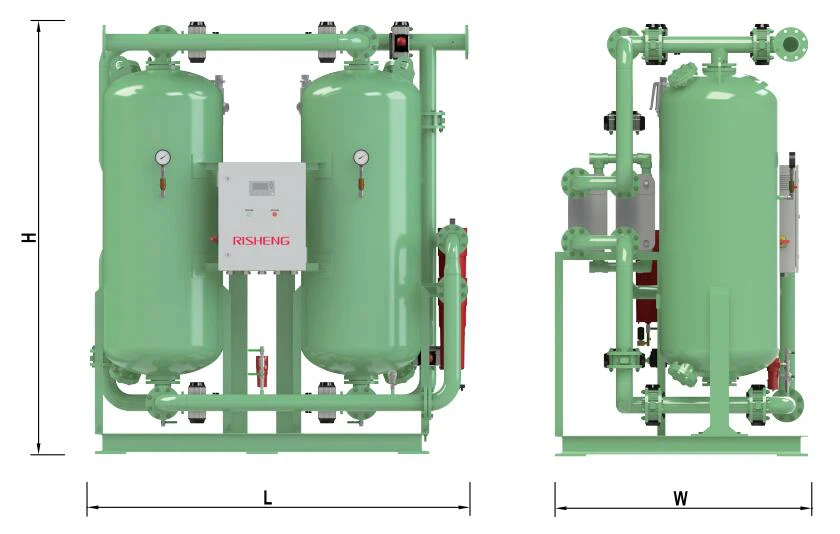
Technical Specification
| Model | Capacity | Connections | Water | Dimension mm | Weight | Recommended | ||||
| m³/min | CFM | Air | Water | Consumption t/h | L | W | H | kg | After-Filter Model | |
| RSXY-60ZP | 6 | 212 | DN50 | 2" | 6.1 | 2000 | 900 | 1900 | 1000 | RSG-AR-0145G/V2 |
| RSXY-80ZP | 8 | 282 | DN50 | 2" | 8.2 | 2000 | 900 | 1900 | 1050 | RSG-AR-0145G/V2 |
| RSXY-100ZP | 10 | 353 | DN50 | 2" | 10.2 | 2066 | 950 | 1916 | 1151 | RSG-AR-0220G/V2 |
| RSXY-120ZP | 12 | 424 | DN50 | 2" | 12.2 | 2066 | 1000 | 2000 | 1250 | RSG-AR-0220G/V2 |
| RSXY-150ZP | 15 | 530 | DN65 | 2" | 15.3 | 2165 | 1000 | 2316 | 1550 | RSG-AR-0330G/V2 |
| RSXY-200ZP | 20 | 706 | DN65 | 2" | 20.4 | 2225 | 1000 | 2567 | 1640 | RSG-AR-0330G/V2 |
| RSXY-220ZP | 22 | 777 | DN65 | 2" | 22.4 | 2325 | 1050 | 2647 | 1900 | RSG-AR-0430G/V2 |
| RSXY-250ZP | 25 | 883 | DN65 | 2" | 25.5 | 2325 | 1050 | 2647 | 1980 | RSG-AR-0430G/V2 |
| RSXY-350ZP | 35 | 1236 | DN80 | 2" | 35.7 | 2452 | 1250 | 2510 | 2470 | RSG-AR-0620G/V2 |
| RSXY-450ZP | 45 | 1589 | DN100 | 3" | 45.9 | 2900 | 1400 | 2690 | 3000 | RSG-AR-0830F/V2 |
| RSXY-600ZP | 60 | 2119 | DN100 | 3" | 61.2 | 3100 | 1650 | 2717 | 3800 | RSG-AR-1000F/V2 |
|
Rated Conditions |
Working Range |
Avaliable |
 |
|
Working pressure : 0.7MPag / 100psig |
Max.working pressure : 1.0MPag / 145psig |
Higher pressure above 1.0Mpag / 145psig |
|
|
Inlet temp : 160 ℃ / 320 ℉ |
Max.inlet temp : 200℃ / 394 ℉ |
Booster heater |
|
|
Cooling water temp : 32℃ / 90 ℉ |
Max.ambient temperature : 40℃ / 104 ℉ |
Higher capacity |
|
|
Stainless steel vessel or piping |
|||
|
GB,ASME,PED,etc. vessels |
|||
|
Zero loss drain |
Applications
1. Pharmaceutical Industry
In pharmaceutical manufacturing, maintaining strict humidity control is crucial. Desiccant bed dryers are extensively used to dry pharmaceutical raw materials, such as powders and granules. For example, during the production of solid - dosage medications like tablets and capsules, the raw materials need to be dried to a specific moisture content to ensure their stability, shelf - life, and efficacy. The desiccant bed dryer can precisely remove moisture, preventing issues like mold growth, chemical degradation, and caking of the materials.
2. Food and Beverage Industry
The food and beverage industry relies on desiccant bed dryers for multiple applications. In the production of dried fruits, nuts, and grains, these dryers are used to reduce the moisture content to a level that inhibits the growth of bacteria, yeast, and molds, extending the shelf - life of the products. In the beverage industry, it can be used to dry the air in storage areas for bottled or canned products, preventing the formation of condensation on the containers, which could lead to label damage or corrosion.
3. Electronics Manufacturing
In electronics manufacturing, even a small amount of moisture can cause significant problems. Desiccant bed dryers are used to dry electronic components during the manufacturing process. For example, before soldering, components like printed circuit boards (PCBs) need to be moisture - free to avoid issues such as solder joint failures, short - circuits, and corrosion. The desiccant bed dryer can effectively remove moisture from the components, ensuring high - quality soldering and reliable performance of the final electronic products.
4. Paint and Coating Industry
In the paint and coating industry, desiccant bed dryers play a vital role. They are used to dry the raw materials used in paint production, such as pigments, resins, and solvents. By reducing the moisture content in these materials, the desiccant bed dryer helps in achieving a consistent quality of the paint. Moisture in paint can cause issues like poor adhesion, blistering, and color fading. The desiccant bed dryer can dry the compressed air used in the coating equipment, ensuring that the applied coatings are smooth, defect - free, and have optimal durability.
Correction Factors
Actual Capacity (m³/min) = Nominal Capacity × KA × KB
| Working Pressure (KA) | Mpag | 0.5 | 0.6 | 0.7 | 0.8 | 0.9 | 1 |
| psig | 73 | 87 | 100 | 116 | 131 | 145 | |
| CFP | 0.75 | 0.87 | 1 | 1.13 | 1.25 | 1.37 |
| Cooling Water Temperature (KB) | ℃ | 25 | 30 | 32 | 35 |
| ℉ | 77 | 86 | 90 | 95 | |
| CFT | 1.33 | 1.11 | 1 | 0.85 |
FAQ:
Q: How efficient is it in removing moisture from our industrial materials?
A: It is highly efficient in moisture removal. Equipped with advanced desiccant materials, it can reduce the moisture content of most industrial materials to a very low level, meeting strict industry standards.
Q: What is the maintenance requirement for it?
A: The maintenance requirement for it is relatively low. Regularly, you need to check the desiccant condition and replace the desiccant when it reaches saturation. However, compared to some other drying equipment, it has a simple maintenance routine.
Q: Can it be customized to fit our specific production line layout?
A: Yes, it can be customized. Our engineering team can design and modify it according to your production line layout, taking into account factors such as the location of material input and output, available space, and integration with existing equipment. This ensures seamless operation within your production environment.
Q: How long does it take for it to dry a batch of materials?
A: The drying time depends on various factors such as the type of materials, the initial moisture content, and the desired final moisture level. Generally, for common industrial materials, it can complete the drying process within a few hours.
Q: What is the energy consumption of it?
A: It is designed to be energy - efficient. The energy consumption mainly comes from the operation of the blower for air - flow and, if applicable, the heating system for desiccant regeneration. Advanced control systems are used to optimize energy usage, reducing overall costs. Compared to traditional drying methods, it can save a significant amount of energy, making it an environmentally friendly and cost - effective choice for your business.
Q: How reliable is it during continuous operation?
A: It is highly reliable during continuous operation. Built with high - quality components and a robust design, it can withstand long - term continuous use. Redundant systems are often incorporated in critical parts to prevent unexpected failures.


