

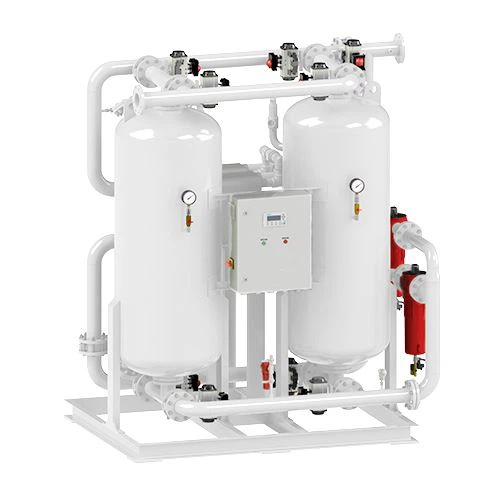
Working Principle
Desiccant air dryers work on a different principle. They use desiccants, which are substances with a strong affinity for water. The compressed air passes through a bed of desiccant material. As the air flows through, the desiccant adsorbs the water vapor in the air. There are two main types of desiccant air dryers: fixed - bed and regenerative. In a fixed - bed desiccant dryer, once the desiccant becomes saturated with water, it needs to be replaced. In a regenerative desiccant dryer, there are usually two beds of desiccant. While one bed is in the adsorption mode, removing moisture from the compressed air, the other bed is being regenerated.
Regeneration can be achieved through heating the desiccant to drive off the adsorbed water or by using a purge of dry air to displace the moisture. In a paint - spraying shop, for instance, a desiccant air dryer is essential. Moisture in the compressed air used for paint spraying can cause the paint to bubble or not adhere properly. The desiccant in the dryer adsorbs the water vapor, providing dry air for a smooth and high - quality paint finish.
Pressure - Swing Regeneration: In pressure - swing regeneration, the pressure within the desiccant bed is adjusted. By reducing the pressure, the desiccant releases the captured moisture. This process typically uses a small amount of the dried air, which is used to carry away the released moisture.
Temperature - Swing Regeneration: For temperature - swing regeneration, external heat is introduced to the desiccant bed. The application of heat causes the desiccant to expel the moisture it has adsorbed. This method allows for the full utilization of the dried air without any loss. Temperature - swing regeneration is particularly useful in settings where air loss cannot be tolerated, such as in high - precision manufacturing processes or sensitive laboratory environments.
Technical Specification
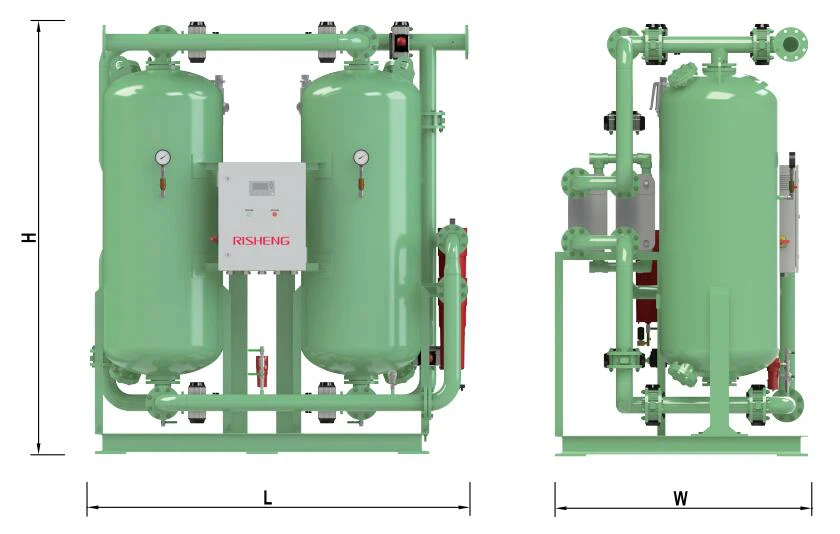
| Model | Capacity | Connections | Water | Dimension mm | Weight | Recommended | ||||
| m³/min | CFM | Air | Water | Consumption t/h | L | W | H | kg | After-Filter Model | |
| RSXY-60ZP | 6 | 212 | DN50 | 2" | 6.1 | 2000 | 900 | 1900 | 1000 | RSG-AR-0145G/V2 |
| RSXY-80ZP | 8 | 282 | DN50 | 2" | 8.2 | 2000 | 900 | 1900 | 1050 | RSG-AR-0145G/V2 |
| RSXY-100ZP | 10 | 353 | DN50 | 2" | 10.2 | 2066 | 950 | 1916 | 1151 | RSG-AR-0220G/V2 |
| RSXY-120ZP | 12 | 424 | DN50 | 2" | 12.2 | 2066 | 1000 | 2000 | 1250 | RSG-AR-0220G/V2 |
| RSXY-150ZP | 15 | 530 | DN65 | 2" | 15.3 | 2165 | 1000 | 2316 | 1550 | RSG-AR-0330G/V2 |
| RSXY-200ZP | 20 | 706 | DN65 | 2" | 20.4 | 2225 | 1000 | 2567 | 1640 | RSG-AR-0330G/V2 |
| RSXY-220ZP | 22 | 777 | DN65 | 2" | 22.4 | 2325 | 1050 | 2647 | 1900 | RSG-AR-0430G/V2 |
| RSXY-250ZP | 25 | 883 | DN65 | 2" | 25.5 | 2325 | 1050 | 2647 | 1980 | RSG-AR-0430G/V2 |
| RSXY-350ZP | 35 | 1236 | DN80 | 2" | 35.7 | 2452 | 1250 | 2510 | 2470 | RSG-AR-0620G/V2 |
| RSXY-450ZP | 45 | 1589 | DN100 | 3" | 45.9 | 2900 | 1400 | 2690 | 3000 | RSG-AR-0830F/V2 |
| RSXY-600ZP | 60 | 2119 | DN100 | 3" | 61.2 | 3100 | 1650 | 2717 | 3800 | RSG-AR-1000F/V2 |
|
Rated Conditions |
Working Range |
Avaliable |
 |
|
Working pressure : 0.7MPag / 100psig |
Max.working pressure : 1.0MPag / 145psig |
Higher pressure above 1.0Mpag / 145psig |
|
|
Inlet temp : 160 ℃ / 320 ℉ |
Max.inlet temp : 200℃ / 394 ℉ |
Booster heater |
|
|
Cooling water temp : 32℃ / 90 ℉ |
Max.ambient temperature : 40℃ / 104 ℉ |
Higher capacity |
|
|
Stainless steel vessel or piping |
|||
|
GB,ASME,PED,etc. vessels |
|||
|
Zero loss drain |
Applications
1. Manufacturing Industry
In manufacturing, shop air dryers are widely used. Pneumatic machinery and tools, such as air compressors, drills, and impact wrenches, rely on clean and dry air. Moisture in the air can cause corrosion in the internal components of these tools, reducing their lifespan and performance. This not only extends the life of the tools but also improves the quality of the assembly process.
2. Food and Beverage Industry
The food and beverage industry has strict hygiene and quality requirements. Shop air dryers play a vital role here. Compressed air is used in various processes, such as filling bottles, packaging food products, and operating pneumatic valves in food processing equipment. Moisture in the air can introduce bacteria and mold, contaminating the food and beverage products. By using a shop air dryer, the bakery can ensure that the air used in these processes is dry and free from contaminants, thus maintaining the quality and safety of the baked goods.
3. Healthcare and Pharmaceutical Industry
In the healthcare and pharmaceutical sectors, clean and dry compressed air is critical. Compressed air is used in medical devices such as respirators, dental equipment, and pharmaceutical manufacturing processes. In a hospital's central air supply system for medical devices, shop air dryers are installed to remove moisture. Moisture - laden air could potentially introduce pathogens into the medical devices, endangering patients. In pharmaceutical manufacturing, dry air is required to prevent the degradation of drugs during production and packaging. Any moisture present could affect the stability and efficacy of the pharmaceutical products.
4. Automotive Repair Shops
Automotive repair shops use a variety of pneumatic tools, from tire inflators to air - powered grinders. Shop air dryers are essential in these settings to keep the air supply clean and dry. Moisture in the air can cause rust in the air lines and tools, and it can also affect the performance of pneumatic tire inflators, leading to inaccurate tire pressure readings. With a shop air dryer, mechanics can ensure that their tools are in optimal condition and that the air - related operations in the repair shop are carried out smoothly.
Correction Factors
Actual Capacity (m³/min) = Nominal Capacity × KA × KB
| Working Pressure (KA) | Mpag | 0.5 | 0.6 | 0.7 | 0.8 | 0.9 | 1 |
| psig | 73 | 87 | 100 | 116 | 131 | 145 | |
| CFP | 0.75 | 0.87 | 1 | 1.13 | 1.25 | 1.37 |
| Cooling Water Temperature (KB) | ℃ | 25 | 30 | 32 | 35 |
| ℉ | 77 | 86 | 90 | 95 | |
| CFT | 1.33 | 1.11 | 1 | 0.85 |
FAQ:
Q: How effectively does it remove moisture from compressed air to meet the high - standard requirements of our manufacturing processes?
A: It removes moisture from compressed air with high efficiency, ensuring that the air quality meets the strict demands of various manufacturing processes. Utilizing advanced drying technologies, such as desiccant - based or refrigeration - type systems, it can achieve extremely low dew - points. For instance, in precision machining or painting operations where even trace amounts of moisture can cause defects, it can reduce the dew - point to levels well below - 40°C. This consistent moisture removal helps prevent corrosion of equipment, ensures the quality of finished products, and maintains the smooth operation of pneumatic tools and machinery.
Q: What is the maintenance routine and associated costs for it in a busy workshop with continuous operation?
A: In a continuously operating busy workshop, the maintenance routine for it typically includes regular inspections. For desiccant - type dryers, the desiccant material may need replacement every 1 - 3 years, depending on usage and air quality. Refrigeration - type dryers require periodic checks of the refrigerant levels, condenser coils, and fans. The associated costs cover replacement parts, such as desiccant cartridges, filters, or refrigerant, along with labor costs for trained technicians to perform maintenance tasks. However, compared to potential losses caused by equipment damage due to moisture - laden air, the long - term maintenance costs of the shop air dryer are a worthwhile investment to ensure uninterrupted production.
Q: How easily can it be integrated into our existing compressed air system in the workshop without causing significant disruptions?
A: It can be integrated into your existing workshop compressed air system with relative ease. Most shop air dryers are designed to be installed in - line and come with standard connection fittings that are compatible with common compressed air pipes. The installation process usually involves connecting the dryer to the main air line, power supply, and drainage system. With proper planning and the help of a qualified technician, the integration can often be completed within a few hours to a day, minimizing production downtime. Some models also offer features like quick - connect ports and modular designs, further simplifying the installation process.
Q: How energy - efficient is it, and what impact will it have on our workshop's electricity bills?
A: It is designed to be energy - efficient, which has a positive impact on your workshop's electricity bills. Modern shop air dryers incorporate energy - saving features such as variable - speed compressors, smart controls that adjust the drying process based on air demand, and efficient heat - exchange mechanisms. For example, refrigeration - type dryers use optimized cooling cycles to minimize power consumption, while desiccant - type dryers can be configured to regenerate desiccant during off - peak hours. Over time, these energy - saving features can lead to significant reductions in electricity costs, especially in workshops with high - volume and continuous compressed air usage.
Q: Can it be customized to meet the specific flow rate and pressure requirements of our unique workshop operations?
A: Yes, it can be customized to meet the specific flow rate and pressure requirements of your workshop. Manufacturers offer a range of models with different capacities, and in many cases, can adjust key components to fit your needs. Whether your workshop requires a high - flow dryer for large - scale production or a dryer that can handle specific pressure ranges for specialized equipment, the design can be tailored accordingly. This customization ensures that the air dryer operates at peak efficiency, providing the right amount of dry compressed air for your unique manufacturing processes.
Q: How durable is it in a workshop environment with dust, vibrations, and temperature fluctuations?
A: It is built to be highly durable in the challenging workshop environment. The casing and internal components are constructed from robust materials that can withstand dust, vibrations, and temperature variations. Dust - resistant filters are installed to prevent particulate matter from entering the dryer and causing damage to internal parts. Vibration - dampening features protect sensitive components, and the dryer is designed to operate within a wide temperature range. With proper care and regular maintenance, it can provide reliable performance over an extended period, even in harsh and demanding workshop conditions.


