


Quality assurance
Stable performance | Strong compressibility | Strong power
High-pressure adsorption cylinder: high efficiency, long-term use
Gas control filter: sensitive gas control filter to ensure gas drying effect
Personalized control panel: The operating status is clear at a glance, and the monitoring system monitors the operation in real time.
Reasons for choosing us:
Stable body, low noise, door-to-door installation, low energy consumption, stable operation
1.Working principle
Adsorption Principle
The dual tower regenerative desiccant air dryer operates based on the adsorption characteristics of desiccants. Desiccants like activated alumina, silica gel, and molecular sieves have a strong affinity for water. When humid compressed air enters one of the adsorption towers filled with these desiccants, the water vapor in the air is adsorbed by the desiccant.
Regeneration Principle
Once the desiccant in an adsorption tower becomes saturated with water, it must be regenerated to regain its adsorption capacity. There are two main methods for regeneration.
Heating Regeneration: In this approach, heat is applied to the saturated desiccant. As the temperature rises, the adsorbed water molecules gain enough energy to evaporate. The water vapor is then carried away by a flowing air stream, which is typically a small portion of the dried compressed air. This heated air passes through the desiccant bed, desorbing the water and restoring the desiccant's ability to adsorb moisture in subsequent cycles.
Non - Thermal Regeneration: This method utilizes the expansion of a part of the dried compressed air after depressurization. When the compressed air expands, it cools down, creating a low - temperature air stream. This cold air is then used to purge the saturated desiccant. The low - temperature air flow sweeps through the desiccant bed, removing the adsorbed water molecules and regenerating the desiccant.
2. Structural Composition
Adsorption Tower
The adsorption tower is the heart of the dual tower regenerative desiccant air dryer. There are two such towers in the system, each filled with desiccant material. One tower is actively engaged in the adsorption process, drying the incoming humid compressed air. Simultaneously, the other tower undergoes the regeneration process. A series of switching valves enable the seamless transition between the two towers. This allows for continuous operation of the air dryer, ensuring a constant supply of dry compressed air without interruption.
Control System
The control system plays a crucial role in the proper functioning of the dual tower regenerative desiccant air dryer. It is responsible for regulating the switching of the adsorption towers, controlling the regeneration time, and monitoring various operational parameters. There are two prevalent types of control systems.
Time - Control System: This system is programmed to switch the adsorption towers and initiate the regeneration process at pre - set time intervals. For example, it may be set to switch the towers every few hours, depending on the expected moisture load and the performance characteristics of the desiccant. While simple to implement, it may not be as energy - efficient in all situations as it does not take into account the actual moisture content of the compressed air.
Dew - Point Control System: A more advanced approach, the dew - point control system continuously monitors the dew - point temperature of the compressed air. Based on this real - time data, it automatically adjusts the regeneration cycle. If the dew - point temperature of the compressed air starts to rise, indicating an increase in moisture content, the system will initiate the regeneration process earlier. This ensures that the desiccant is regenerated only when necessary, leading to significant energy savings and more accurate control of the air dryer's performance.
Valve
A set of valves is an essential component of the dual tower regenerative desiccant air dryer. These valves include the air intake valve, which controls the entry of humid compressed air into the adsorption tower, the air outlet valve, through which dry air exits the system, and the regeneration valve. By precisely controlling the opening and closing of these valves, the dryer can smoothly switch between the adsorption and regeneration modes, ensuring the efficient operation of the entire system.
Technical Specification
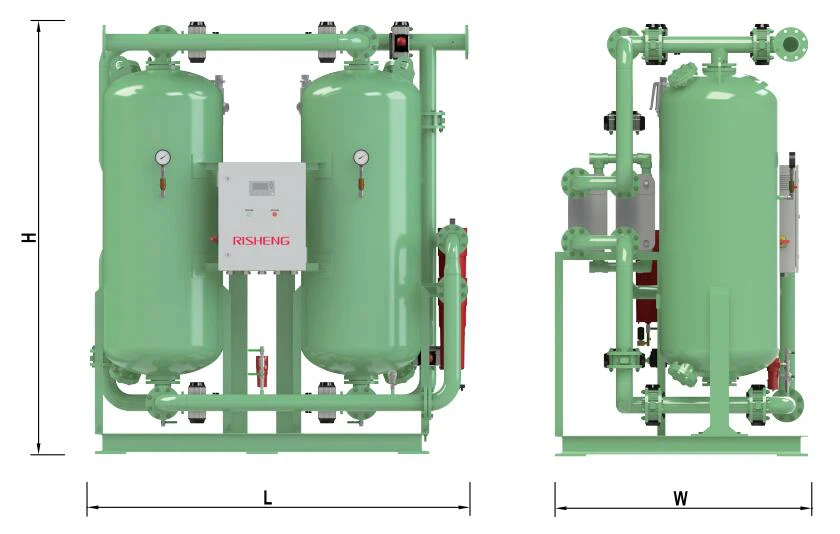
| Model | Capacity | Connections | Water | Dimension mm | Weight | Recommended | ||||
| m³/min | CFM | Air | Water | Consumption t/h | L | W | H | kg | After-Filter Model | |
| RSXY-60ZP | 6 | 212 | DN50 | 2" | 6.1 | 2000 | 900 | 1900 | 1000 | RSG-AR-0145G/V2 |
| RSXY-80ZP | 8 | 282 | DN50 | 2" | 8.2 | 2000 | 900 | 1900 | 1050 | RSG-AR-0145G/V2 |
| RSXY-100ZP | 10 | 353 | DN50 | 2" | 10.2 | 2066 | 950 | 1916 | 1151 | RSG-AR-0220G/V2 |
| RSXY-120ZP | 12 | 424 | DN50 | 2" | 12.2 | 2066 | 1000 | 2000 | 1250 | RSG-AR-0220G/V2 |
| RSXY-150ZP | 15 | 530 | DN65 | 2" | 15.3 | 2165 | 1000 | 2316 | 1550 | RSG-AR-0330G/V2 |
| RSXY-200ZP | 20 | 706 | DN65 | 2" | 20.4 | 2225 | 1000 | 2567 | 1640 | RSG-AR-0330G/V2 |
| RSXY-220ZP | 22 | 777 | DN65 | 2" | 22.4 | 2325 | 1050 | 2647 | 1900 | RSG-AR-0430G/V2 |
| RSXY-250ZP | 25 | 883 | DN65 | 2" | 25.5 | 2325 | 1050 | 2647 | 1980 | RSG-AR-0430G/V2 |
| RSXY-350ZP | 35 | 1236 | DN80 | 2" | 35.7 | 2452 | 1250 | 2510 | 2470 | RSG-AR-0620G/V2 |
| RSXY-450ZP | 45 | 1589 | DN100 | 3" | 45.9 | 2900 | 1400 | 2690 | 3000 | RSG-AR-0830F/V2 |
| RSXY-600ZP | 60 | 2119 | DN100 | 3" | 61.2 | 3100 | 1650 | 2717 | 3800 | RSG-AR-1000F/V2 |
|
Rated Conditions |
Working Range |
Avaliable |
 |
|
Working pressure : 0.7MPag / 100psig |
Max.working pressure : 1.0MPag / 145psig |
Higher pressure above 1.0Mpag / 145psig |
|
|
Inlet temp : 160 ℃ / 320 ℉ |
Max.inlet temp : 200℃ / 394 ℉ |
Booster heater |
|
|
Cooling water temp : 32℃ / 90 ℉ |
Max.ambient temperature : 40℃ / 104 ℉ |
Higher capacity |
|
|
Stainless steel vessel or piping |
|||
|
GB,ASME,PED,etc. vessels |
|||
|
Zero loss drain |
Application
1. Pharmaceutical industry: In the pharmaceutical production process, the quality of compressed air is extremely high, and any trace of moisture may affect the quality and stability of the drug. The double-tower regenerative desiccant air dryer provides dry and sterile compressed air for the mixing, stirring, packaging and other links of the drug. In the sterile drug production workshop, dry compressed air is used to drive equipment and convey materials to avoid the introduction of microorganisms and moisture due to humid air, ensure that the drugs meet strict quality standards, and ensure the safety of patients' medication.
2. Food and beverage industry: The production of food and beverages requires clean and dry compressed air to ensure the hygiene, safety and quality of the products. Dryers are widely used in the canning, blowing, and conveying processes of food and beverages. In the beverage canning process, dry compressed air is used to clean bottles and drive the canning equipment to prevent moisture and impurities from contaminating beverages, ensuring the taste and shelf life of the product.
3. Electronic industry: The production of electronic components is extremely sensitive to environmental humidity, and even slight changes in moisture content may lead to product quality problems. The double-tower regenerative desiccant air dryer provides ultra-dry compressed air for the electronics industry, which is used in chip manufacturing, circuit board welding, and electronic product assembly. In the chip manufacturing process, dry compressed air is used in high-precision processes such as lithography and etching to prevent moisture from oxidizing or corroding the chip surface and ensure the performance and reliability of the chip.
4. Chemical industry: Many processes in chemical production require dry compressed air as a power source or to participate in chemical reactions. Dryers can be used for the transportation of chemical raw materials, pressure control of reactors, gas separation and other processes. In chemical synthesis reactions, dry compressed air is used as a carrier of reaction gases to ensure that the reaction is carried out in an anhydrous environment and improve the selectivity and yield of the reaction. At the same time, dry compressed air can also be used for purging and cleaning of chemical equipment to prevent corrosion and blockage due to moisture accumulation inside the equipment, and ensure the safety and stability of chemical production.
5. Automobile manufacturing industry: In the automobile manufacturing process, a large amount of clean and dry compressed air is required from the processing of parts to the assembly of the whole vehicle. Double-tower regenerative desiccant air dryers are used in automobile painting, parts cleaning, pneumatic tool driving and other links. In the automobile painting process, dry compressed air ensures uniform spraying of paint mist, avoids defects such as bubbles and sagging on the paint surface due to moisture mixing, and improves the appearance quality of the car.
FAQ
1. Q: How efficiently does it reduce the moisture content in compressed air to meet the high - quality air requirements of our manufacturing processes?
A: It is highly efficient in reducing moisture content. The dual - tower design allows for continuous operation. While one tower is drying the compressed air, the other is being regenerated. The desiccant material inside, such as molecular sieves or activated alumina, has a high affinity for water vapor. It can lower the dew point of compressed air significantly, often achieving dew points as low as - 40°C or even lower. This level of moisture removal is crucial for manufacturing processes like semiconductor production, where even trace amounts of moisture can cause defects in the products.
2. Q: What is the energy consumption of it, and are there any energy - saving features available to lower our operating costs?
A: Its energy consumption depends on factors like the dryer's size, the type of regeneration method (heat - less, heated, or heat - of - compression), and the operating conditions. However, modern dual - tower regenerative desiccant air dryers come with several energy - saving features. For example, some models use variable - speed drives to adjust the airflow according to the actual demand for dry air. This ensures that the dryer consumes only the necessary amount of energy. In heat - less regeneration systems, advanced control algorithms are used to optimize the purge air volume, reducing the amount of compressed air wasted during the regeneration process.
3. Q: How reliable is it in continuous operation, considering the demanding nature of our industrial environment with potential contaminants and high - pressure conditions?
A: It is engineered to be highly reliable in continuous operation within demanding industrial environments. The towers are constructed from durable materials that can withstand high pressures and resist the corrosive effects of contaminants present in compressed air, such as oil vapor and chemical impurities. The desiccant material is also selected for its long - term stability and resistance to degradation. These systems can detect any abnormal operating conditions, such as high temperatures, pressure imbalances, or desiccant saturation, and take corrective actions automatically. This ensures that it can operate continuously without interruption, minimizing production downtime and maintaining the quality of your compressed air supply.
4. Q: Can it be integrated with our existing compressed air system, and what kind of support do you offer for the integration process?
A: Yes, it can be seamlessly integrated with your existing compressed air system. The integration process involves ensuring proper sizing of the dryer to match the capacity of your compressed air generation equipment. The inlet and outlet connections of the dryer need to be compatible with your existing pipework. In terms of control, it can be interfaced with your overall compressed air system's monitoring and control network. We offer comprehensive support for the integration process. Our technical team can provide detailed installation guidelines, assist with any software - related configuration, and offer on - site commissioning services if required.


