


1. Excellent running stability
Uniform air flow design: equipped with air flow distributor and other devices, so that the compressed air entering the drying tower can evenly pass through the adsorbent layer, avoid excessive or insufficient local adsorption, extend the service life of the adsorbent, and ensure the stability of the drying effect.
Pressure stability maintenance: The optimized control system and valve design can effectively maintain the pressure stability during the operation of the equipment, reduce the influence of pressure fluctuations on the adsorption and regeneration process, and ensure that the dryer can operate reliably under different working conditions.
2. Outstanding energy-saving and environmental protection features
Non-thermal/micro-thermal regeneration technology: The non-thermal regeneration type uses the low-temperature drying effect caused by the decompression and expansion of some air after drying to regenerate, without additional heating energy; The micro-thermal regeneration type only needs to heat a small amount of regas, which greatly reduces energy consumption compared with the thermal regeneration dryer and meets the requirements of energy conservation and emission reduction.
Low gas consumption design: Reasonable design of regenerative gas, under the premise of ensuring adequate regeneration of adsorbent, as far as possible to reduce the consumption of re-gas, reduce the waste of compressed air, improve energy efficiency.
3. Easy operation and maintenance
Automatic operation: Equipped with advanced automatic control system, can achieve one-click start, automatic switch adsorption and regeneration state, fault alarm and other functions, reduce manual operation intensity and error, improve the reliability of equipment operation and management efficiency.
Low maintenance cost: relatively simple structure, few main components, and long service life of adsorbent, long replacement cycle; At the same time, the repair and maintenance of the equipment is more convenient, without professional technicians and complex tools, reducing maintenance costs and downtime.
4. Reliable safety performance
Multiple protection functions: Set the pressure safety valve, temperature protection device and other safety facilities, when the internal pressure or temperature of the equipment exceeds the set value, can automatically start the protection mechanism to prevent the equipment explosion, fire and other safety accidents.
Material safety and durability: The main components such as the drying tower are made of high-strength and corrosion-resistant materials, which can withstand high working pressure and harsh working environment to ensure the safety and stability of the equipment during long-term operation.
5. Strong adaptability and flexibility
Wide adaptability: According to different air intake conditions (such as temperature, pressure, humidity, etc.) and gas requirements, flexible adjustment of operating parameters and configuration, to adapt to a variety of complex industrial production environment, such as high temperature, high humidity, high dust and other conditions.
Good flow scalability: there are a variety of specifications and models to choose from, processing gas from small laboratory scale to large industrial production of large flow requirements can be met, and can be combined by parallel or series, to achieve flow expansion and system optimization.
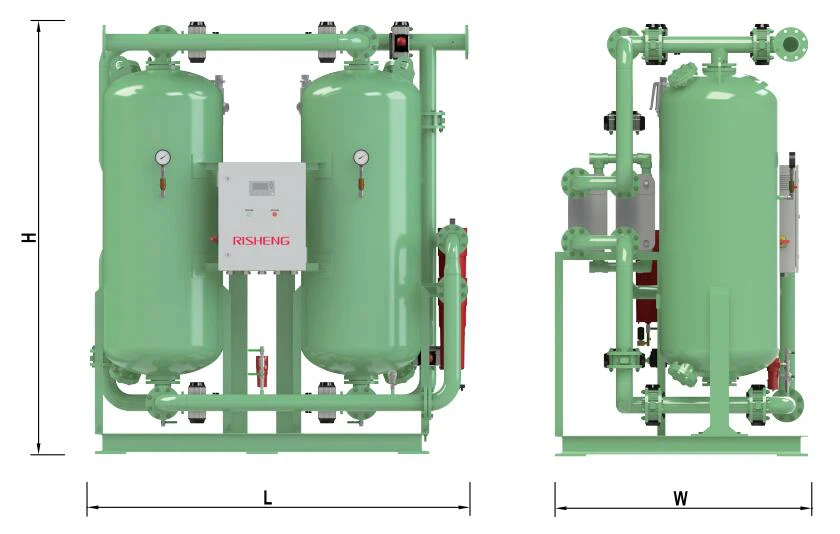
Technical Specification
| Model | Capacity | Connections | Water | Dimension mm | Weight | Recommended | ||||
| m³/min | CFM | Air | Water | Consumption t/h | L | W | H | kg | After-Filter Model | |
| RSXY-60ZP | 6 | 212 | DN50 | 2" | 6.1 | 2000 | 900 | 1900 | 1000 | RSG-AR-0145G/V2 |
| RSXY-80ZP | 8 | 282 | DN50 | 2" | 8.2 | 2000 | 900 | 1900 | 1050 | RSG-AR-0145G/V2 |
| RSXY-100ZP | 10 | 353 | DN50 | 2" | 10.2 | 2066 | 950 | 1916 | 1151 | RSG-AR-0220G/V2 |
| RSXY-120ZP | 12 | 424 | DN50 | 2" | 12.2 | 2066 | 1000 | 2000 | 1250 | RSG-AR-0220G/V2 |
| RSXY-150ZP | 15 | 530 | DN65 | 2" | 15.3 | 2165 | 1000 | 2316 | 1550 | RSG-AR-0330G/V2 |
| RSXY-200ZP | 20 | 706 | DN65 | 2" | 20.4 | 2225 | 1000 | 2567 | 1640 | RSG-AR-0330G/V2 |
| RSXY-220ZP | 22 | 777 | DN65 | 2" | 22.4 | 2325 | 1050 | 2647 | 1900 | RSG-AR-0430G/V2 |
| RSXY-250ZP | 25 | 883 | DN65 | 2" | 25.5 | 2325 | 1050 | 2647 | 1980 | RSG-AR-0430G/V2 |
| RSXY-350ZP | 35 | 1236 | DN80 | 2" | 35.7 | 2452 | 1250 | 2510 | 2470 | RSG-AR-0620G/V2 |
| RSXY-450ZP | 45 | 1589 | DN100 | 3" | 45.9 | 2900 | 1400 | 2690 | 3000 | RSG-AR-0830F/V2 |
| RSXY-600ZP | 60 | 2119 | DN100 | 3" | 61.2 | 3100 | 1650 | 2717 | 3800 | RSG-AR-1000F/V2 |
|
Rated Conditions |
Working Range |
Avaliable |
 |
|
Working pressure : 0.7MPag / 100psig |
Max.working pressure : 1.0MPag / 145psig |
Higher pressure above 1.0Mpag / 145psig |
|
|
Inlet temp : 160 ℃ / 320 ℉ |
Max.inlet temp : 200℃ / 394 ℉ |
Booster heater |
|
|
Cooling water temp : 32℃ / 90 ℉ |
Max.ambient temperature : 40℃ / 104 ℉ |
Higher capacity |
|
|
Stainless steel vessel or piping |
|||
|
GB,ASME,PED,etc. vessels |
|||
|
Zero loss drain |
Correction Factors
Actual Capacity (m³/min) = Nominal Capacity × KA × KB
| Working Pressure (KA) | Mpag | 0.5 | 0.6 | 0.7 | 0.8 | 0.9 | 1 |
| psig | 73 | 87 | 100 | 116 | 131 | 145 | |
| CFP | 0.75 | 0.87 | 1 | 1.13 | 1.25 | 1.37 |
| Cooling Water Temperature (KB) | ℃ | 25 | 30 | 32 | 35 |
| ℉ | 77 | 86 | 90 | 95 | |
| CFT | 1.33 | 1.11 | 1 | 0.85 |
Working process
The dual-tower adsorption air dryer is usually equipped with two towers A and B, and the whole work process is divided into two key stages of adsorption and regeneration, and the two towers perform these two stages alternately to ensure the continuous supply of dry compressed air.
1. Adsorption stage
Intake pretreatment: Moist compressed air rushes in from the air intake of the dryer and first flows through the precision filter. The filter is generally composed of multiple layers of filter media of different materials, such as glass fiber, synthetic fiber, etc., which can efficiently intercept oil droplets, dust, particulate matter and other impurities in the compressed air, ensure that the air entering the drying tower is relatively clean, and avoid impurities causing pollution to the adsorbent, thus affecting the adsorption effect.
Water adsorption: The pre-treated compressed air, driven by pressure, uniformly passes through the adsorbent layer in the adsorbent A tower. The adsorbent is in full contact with the water in the compressed air, and absorbs the water on its own surface and pores by virtue of its strong adsorption capacity. In this process, the adsorption between the adsorbent and water is physical adsorption, that is, the adsorption of water molecules through the intermolecular van der Waals force. As the adsorption process continues, the moisture content in the compressed air gradually decreases, and the purpose of drying is achieved.
Dry air output: The compressed air after deep drying by the adsorbent of Tower A flows out from the top of tower A and is transported to the downstream gas equipment through the pipeline. During the transportation process, the pipeline is usually insulated to prevent the dry air from reabsorbing water due to temperature changes, ensuring that the dry air can stably meet the strict requirements of the production process for dry compressed air.
2. Regeneration stage
Switching operation: When the adsorbent in Tower A absorbs water to a certain extent and is close to saturation, the control system will quickly issue instructions to switch to the regeneration stage. At this time, Tower A stops the adsorption work, and Tower B begins to assume the adsorption task, thus ensuring the continuous supply of dry air. The switching process is achieved through the coordinated action of a series of solenoid valves and pneumatic valves, which have a very fast response speed and can complete the switching of the direction of the air flow in a short time, ensuring a smooth transition of the entire process without causing any impact on downstream gas equipment.
Depressurization and desorption: Tower A is connected with the atmosphere, and the internal pressure is rapidly reduced. In the process of pressure reduction, the water adsorbed on the adsorbent begins to desorption under low pressure conditions and is released from the surface and pores of the adsorbent. This is because as the pressure decreases, the adsorption balance of water on the surface of the adsorbent is broken, and the water molecules obtain enough energy to break free from the bondage of the adsorbent, and break away from the adsorbent in the gaseous form, and discharge the tower with a small amount of re-gas.
Purge regeneration: In order to regenerate the adsorbent more thoroughly, a portion of the dried compressed air is usually introduced as a re-gas. In the micro-thermal regeneration type dryer, the gas will first pass through the electric heater and other heating devices, and heat it to A certain temperature (generally 30-50 ° C higher than the ambient temperature) before entering the A tower. The re-gas after heating can provide additional energy for the desorption of water, speeding up the desorption process, so that the moisture on the adsorbent is more thoroughly carried out of the tower. In the non-thermal regeneration type dryer, the gas is directly into the A tower, relying on its own low pressure and drying characteristics to purge and regenerate the adsorbent.
Pressurization preparation: After the regeneration is completed, Tower A needs to be pressurized to restore the pressure in the tower to the working pressure and prepare for the next adsorption. During the charging process, compressed air is slowly introduced into Tower A through control elements such as regulating valves. The regulating valve can precisely control the intake air flow rate and the pressure rise rate to avoid pressure shock to the adsorbent and equipment damage. In general, the charging time will be set reasonably according to the specifications and working pressure of the equipment to ensure that tower A enters the next adsorption cycle under stable pressure conditions.
FAQ
1. What causes the pressure fluctuation of the adsorption tower?
It may be that the intake filter element is blocked, resulting in increased intake resistance; It may also be a valve failure, such as stuck or leaking; It could also be a leak in the pipe, causing a drop in system pressure.
2. How to determine whether the adsorbent needs to be replaced?
If the dew point of the air after drying increases significantly, the expected drying effect cannot be achieved; Or the adsorption capacity of the adsorbent is significantly reduced, and under normal working conditions, the adsorption tower quickly reaches a saturated state, which may mean that the adsorbent needs to be replaced.
3. How to solve the abnormal noise when the dryer is working?
First of all, determine the source of noise, if the mechanical parts are faulty, check, maintain or replace them, such as lubricating parts, replacing damaged bearings, gears, etc.; If the airflow is caused, check and adjust the airflow channel; If the electrical fault, check the motor and other electrical parts, such as overload, poor contact and other problems to repair or replace.
4. What are the possible causes of automatic control system failure?
May be the control system hardware failure, such as PLC failure, sensor damage, etc.; It may also be a software failure, such as program errors, data loss, etc. It is also possible that the parameters are set incorrectly.
5. What is the specific process of adsorption stage?
First, moist compressed air enters from the air intake and flows through a precision filter to remove impurities such as oil droplets, dust, and particles. Then the pretreated air passes through the adsorbent layer in the adsorption tower under pressure, and the adsorbent absorbs the water in the air on its own surface and pores through physical adsorption. Finally, the dried air flows out from the top of the tower and is transported to the downstream gas equipment through the insulation pipeline.
6. How is the switching operation implemented in the regeneration stage?
When the adsorbent in the adsorption tower is close to saturation, the control system issues instructions, through a series of solenoid valves and pneumatic valves, quickly change the direction of the air flow, so that the adsorption tower stops the adsorption and enters the regeneration stage, while the other tower starts the adsorption work to ensure the continuous supply of dry air.


