

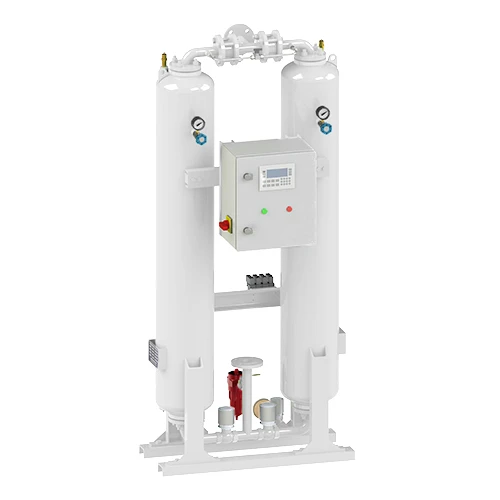
Twin tower desiccant dryer functions on the pressure swing adsorption principle. Since the capacity of air to retain water vapor is inversely related to pressure, two drying towers operate in an alternating fashion. While one tower is in the adsorption phase, compressed air enters it. The desiccant within this tower captures the moisture, yielding dry air. Simultaneously, the other tower is engaged in the regeneration process. A portion of the previously dried air is expanded to atmospheric pressure under reduced pressure, making it even drier. This regenerated air then flows through the desiccant layer in need of regeneration. It extracts the moisture present in the desiccant and carries it out of the dryer, thus fulfilling the dehumidification goal. Through the cyclic operation of these two towers, a continuous supply of dry compressed air is furnished to the user's gas system.
| Specification | Value |
| Capacity Range | 2~200 m³/min |
| Pressure Range | 0.41.0 MPa (410 barg) |
| Max. Inlet Temperature | 50 ℃ |
| Max. Ambient Temperature | 45 ℃ |
| Power Supply | 220V/1Ph/50Hz or 60Hz |
| Pressure Dew Point (PDP) | -20 ℃, -40 ℃, -70 ℃ |
| Rated Condition | |
| - Working Pressure | 0.7 MPa |
| - Inlet Temperature | 38 ℃ |
| - Ambient Temperature | 38 ℃ |
| - Pressure Dew Point (PDP) | -20 ℃ |
| Other | |
| - Regeneration Air Consumption | < 14% |
Superior Dew Point Performance
In sectors such as semiconductors, aerospace, and precision manufacturing, where the demand for ultra - clean and dry air is of the utmost importance, the exceptional drying performance of our dryer is indispensable. By constantly maintaining a consistently low dew point, our twin tower desiccant dryer acts as a reliable shield for delicate machinery and equipment. It prevents potential harm inflicted by moisture, thereby prolonging the service life of the equipment.
Advantages
1. High-efficiency adsorption performance: The interior of the double-tower dryer is filled with high-performance adsorbents, such as activated alumina and molecular sieves. These adsorbents have a huge specific surface area and rich microporous structure, which can efficiently adsorb moisture in compressed air. During the adsorption process, the humid compressed air enters the tower filled with adsorbent, and the moisture is captured by the adsorbent, thereby achieving air drying.
2. Double-tower alternating operation: The equipment adopts a double-tower structure. When one tower is in the adsorption state, the other tower is regenerated. When the adsorbent in the adsorption tower is saturated with adsorption, the system automatically switches to put the regeneration tower into adsorption work, and the original adsorption tower enters the regeneration process. The regeneration process usually desorbs and discharges the moisture on the adsorbent by heating, reducing pressure, etc., so that the adsorbent is reactivated and prepared for the next round of adsorption.
3. Automation control: The double-tower dryer is equipped with an advanced automation control system that can monitor the operating status of the equipment in real time, such as the humidity, temperature, pressure and other parameters of the inlet and outlet air. According to the set parameter range, the system automatically controls the switching, regeneration and other operation processes of the equipment to achieve unattended operation.
4. Energy-saving design: Energy-saving factors are fully considered in the design, and the energy consumption of the equipment is reduced by optimizing the regeneration process and heat recovery. For example, waste heat regeneration technology is used to regenerate the adsorbent using the heat of the compressed air itself, reducing additional energy consumption.
5. Reliable structural design: The tower, pipelines and connectors of the dryer are made of high-quality materials with good pressure resistance and corrosion resistance. The equipment has a compact structure, small footprint, and is easy to install and maintain.
| Model | Capacity | Installed | Demension mm | Weight (kg) |
Air Connection |
Recommended Pre-Filter Model |
Recommended After-Filter Model |
|||
| m³/min | CFM | Power (kW) | L | W | H | |||||
| RSXW-20 | 2 | 71 | 0.2 | 779 | 549 | 1788 | 198 | DN25 | RSG-AA-0058G/V2 | RSG-AR-0058G/V2 |
| RSXW-30 | 3 | 106 | 0.2 | 839 | 549 | 1703 | 325 | DN25 | RSG-AA-0058G/V2 | RSG-AR-0058G/V2 |
| RSXW-60 | 6 | 212 | 0.2 | 1060 | 618 | 2020 | 510 | DN40 | RSG-AA-0145G/V2 | RSG-AR-0145G/V2 |
| RSXW-80 | 8 | 282 | 0.2 | 1060 | 618 | 2020 | 520 | DN40 | RSG-AA-0145G/V2 | RSG-AR-0145G/V2 |
| RSXW-100 | 10 | 353 | 0.2 | 1200 | 738 | 1824 | 585 | DN50 | RSG-AA-0220G/V2 | RSG-AR-0220G/V2 |
| RSXW-120 | 12 | 424 | 0.2 | 1200 | 738 | 1824 | 600 | DN50 | RSG-AA-0220G/V2 | RSG-AR-0220G/V2 |
| RSXW-150 | 15 | 530 | 0.2 | 1200 | 733 | 2028 | 680 | DN50 | RSG-AA-0330G/V2 | RSG-AR-0330G/V2 |
| RSXW-200 | 20 | 706 | 0.2 | 1500 | 914 | 1973 | 870 | DN65 | RSG-AA-0330G/V2 | RSG-AR-0330G/V2 |
| RSXW-250 | 25 | 883 | 0.2 | 1530 | 962 | 2056 | 975 | DN65 | RSG-AA-0430G/V2 | RSG-AR-0430G/V2 |
| RSXW-300 | 30 | 1059 | 0.2 | 1630 | 1199 | 2019 | 1150 | DN80 | RSG-AA-0620G/V2 | RSG-AR-0620G/V2 |
| RSXW-350 | 35 | 1236 | 0.2 | 1790 | 1207 | 2049 | 1275 | DN80 | RSG-AA-0620G/V2 | RSG-AR-0620G/V2 |
| RSXW-400 | 40 | 1412 | 0.2 | 1830 | 1232 | 2059 | 1350 | DN80 | RSG-AA-0620G/V2 | RSG-AR-0620G/V2 |
| RSXW-500 | 50 | 1766 | 0.2 | 2012 | 1293 | 2238 | 1600 | DN100 | RSG-AA-0830F/V2 | RSG-AR-0830F/V2 |
| RSXW-600 | 60 | 2119 | 0.2 | 2150 | 1321 | 2518 | 2100 | DN100 | RSG-AA-1000F/V2 | RSG-AR-1000F/V2 |


FAQ
1. Q: How effectively does it remove moisture from compressed air to meet the strict requirements of our industrial processes?
A: It is highly effective in removing moisture from compressed air. Twin - tower desiccant dryers operate on a cyclic process where one tower is drying the compressed air while the other is being regenerated. The desiccant material, such as activated alumina or molecular sieves, has a high affinity for water vapor. It can reduce the dew point of compressed air to extremely low levels, often well below - 40°C or even lower, depending on the type of desiccant and the dryer's design. This level of moisture removal is crucial for industrial processes like electronics manufacturing, where even trace amounts of moisture can damage sensitive components, or in the food and beverage industry to prevent product spoilage.
2. Q: What is the energy consumption of it, and how can we optimize energy usage without sacrificing drying performance?
A: Its energy consumption depends on several factors, including the size of the dryer, the type of regeneration system (heat - less, heated, or heat - of - compression), and the operating conditions. Heat - less dryers, for example, consume a significant amount of compressed air for regeneration, which indirectly uses energy. However, modern twin - tower desiccant dryers are designed with energy - saving features. Some models use variable - speed drives to adjust the airflow based on the actual demand, reducing energy waste. To optimize energy usage without sacrificing drying performance, you can also schedule the dryer's operation according to your production needs.
3. Q: How reliable is it in continuous operation, considering the high - stress nature of industrial environments?
A: It is engineered to be highly reliable in continuous operation within industrial environments. The towers are constructed from durable materials that can withstand high pressures and the corrosive effects of certain contaminants in the compressed air. The control systems are designed to be robust, with redundant components in some cases to prevent system failures. Additionally, regular maintenance, such as desiccant replacement and filter cleaning, can be easily scheduled to ensure long - term reliable operation. In industrial settings where uninterrupted supply of dry compressed air is essential, it can operate continuously for extended periods, minimizing downtime and production losses.
4. Q: Can it be integrated with our existing compressed air system, and what are the integration requirements?
A: Yes, it can be integrated with your existing compressed air system. The integration requirements typically involve proper sizing of the dryer to match the capacity of your compressed air generation equipment. You need to ensure that the inlet and outlet connections of the dryer are compatible with the pipework of your existing system. In terms of control, it should be able to interface with your overall compressed air system's monitoring and control system. This may require the use of standard communication protocols, such as Modbus or Profibus, to enable seamless integration. Once integrated, it can work in harmony with your existing setup, providing efficient moisture removal for your compressed air needs.


